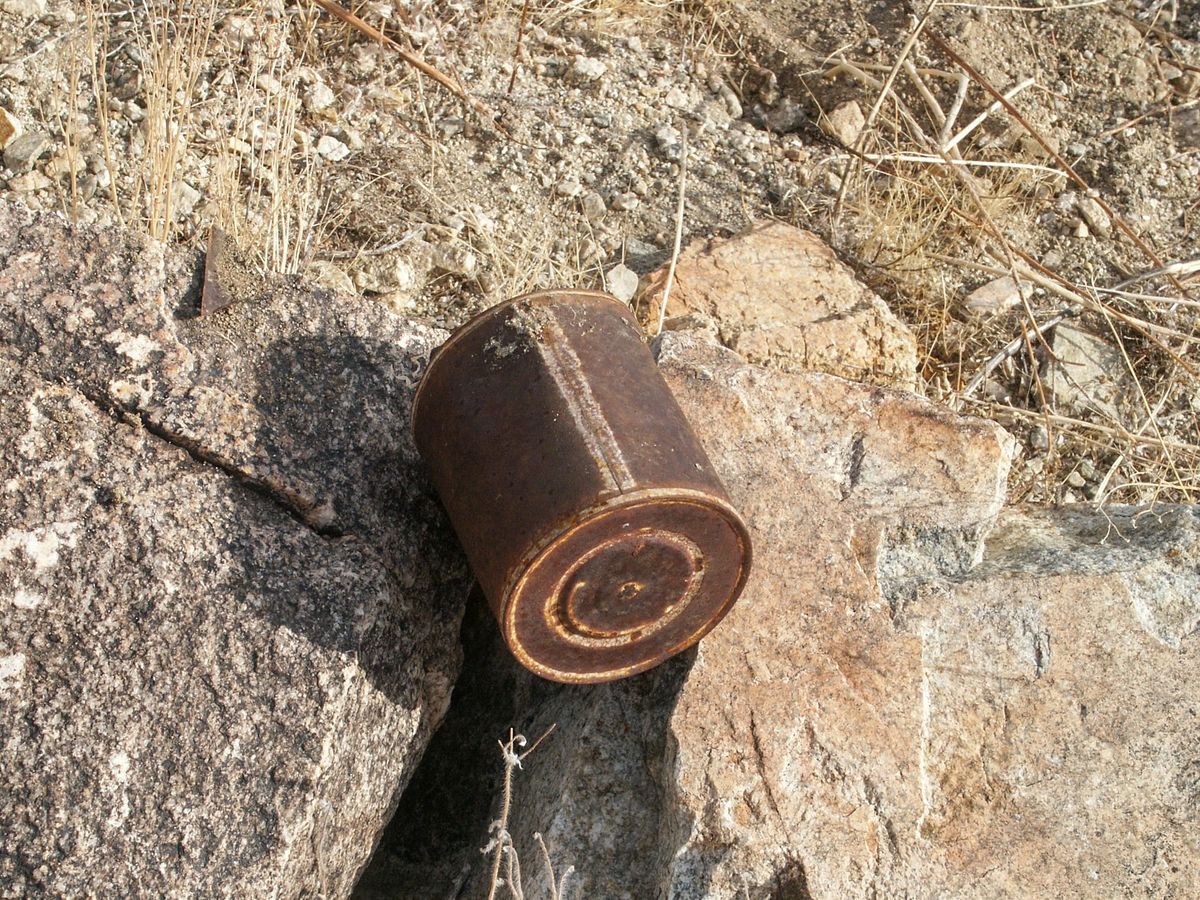
Using artifacts to date historical sites
Cans
Food cans are widely overlooked as a good indicator of when a historical site was inhabited. And often, they are the only things left. What follows below is a basic guide.
One caution about the dates. A can's date is a floor, not a ceiling: the trash was left in that year or later, not earlier. Old stock sat on store shelves for years after a type went out of production, longer still in the backcountry, and anyone can carry an old can in and leave it behind. Judge a site by the mix of its cans, not by one.
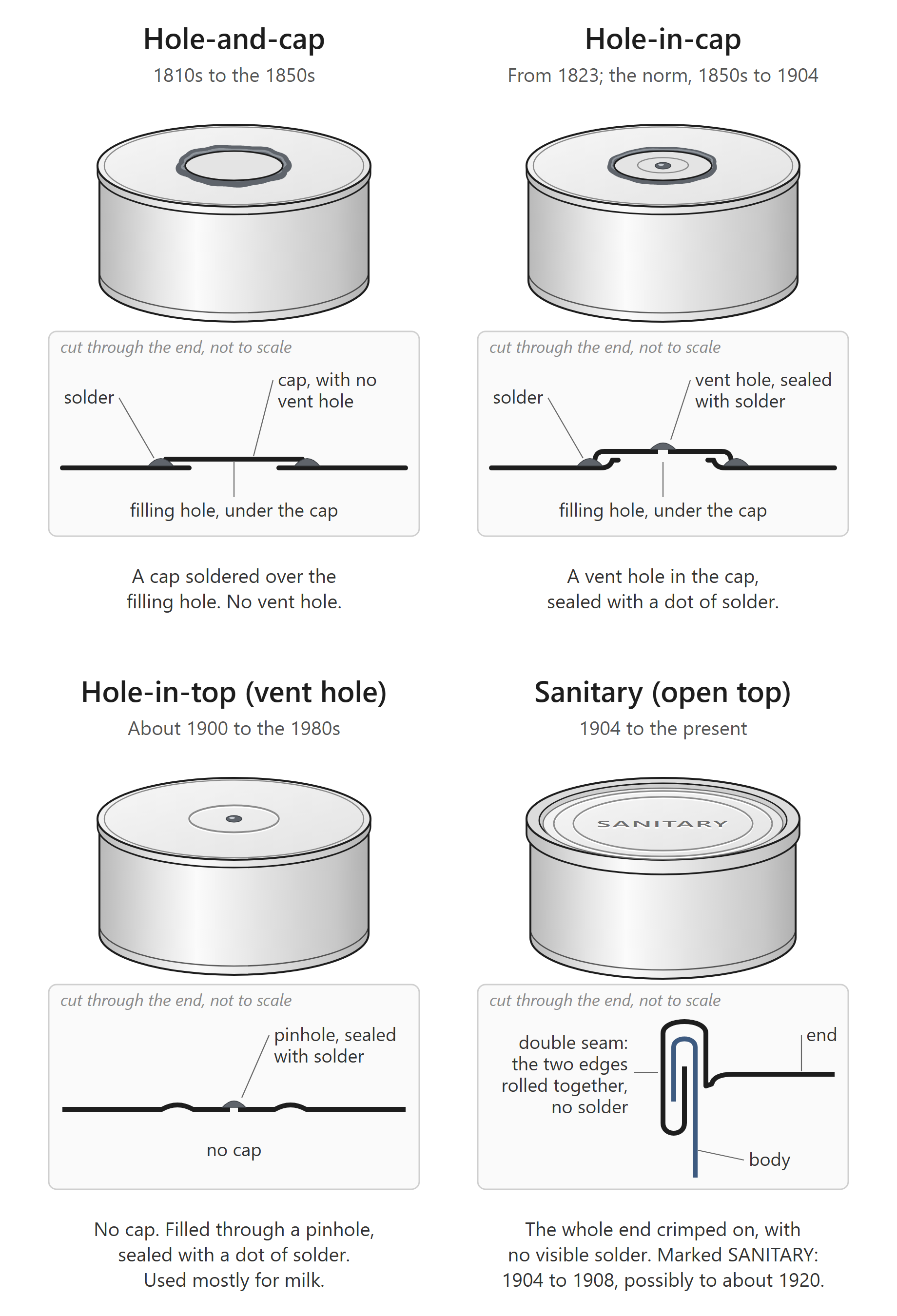
The earliest cans have solder on all of their seams and are of the so-called "Hole-and-cap" design. Food was put in through the hole, and a cap was added and sealed with solder. There was no vent hole in these cans. In 1823 the cap gained a center vent hole, and the "Hole-in-cap" can was born. Caps without one stayed common into the late 1840s, though, and the vented cap was not the norm until the 1850s.
The can was heated and the cap was put on after the food was added to the can. The can vented through the hole while being heated, after which the vent hole was sealed with a dab of solder. At the time, nobody knew that bacteria cause food spoilage, and the air itself was thought to be the cause. Unfortunately, the terms Hole-and-cap and Hole-in-cap are sometimes confused with each other and used interchangeably. The difference is the center vent hole in the cap. Hole-and-cap designs lack a soldered center hole. Hole-and-cap cans are also understandably rare since they are so old. I've seen only a few in the wild.
A cap with no vent hole is not proof of an early can, though. From 1885 into the 1940s, some condensed milk cans were closed with a pressed-in cap that had no vent hole and no solder. The early hole-and-cap has a bead of solder around its cap; the milk can caps have none.
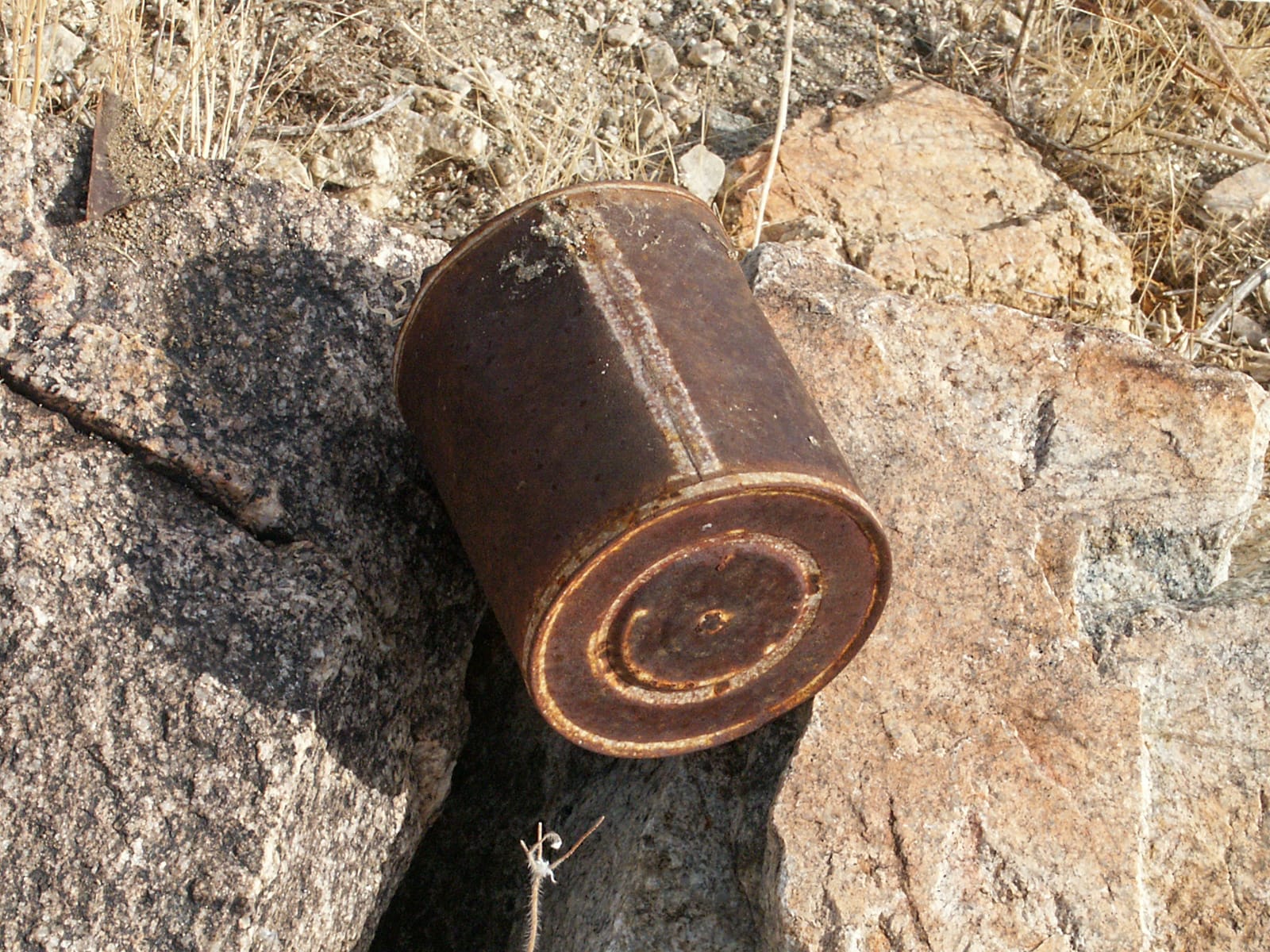
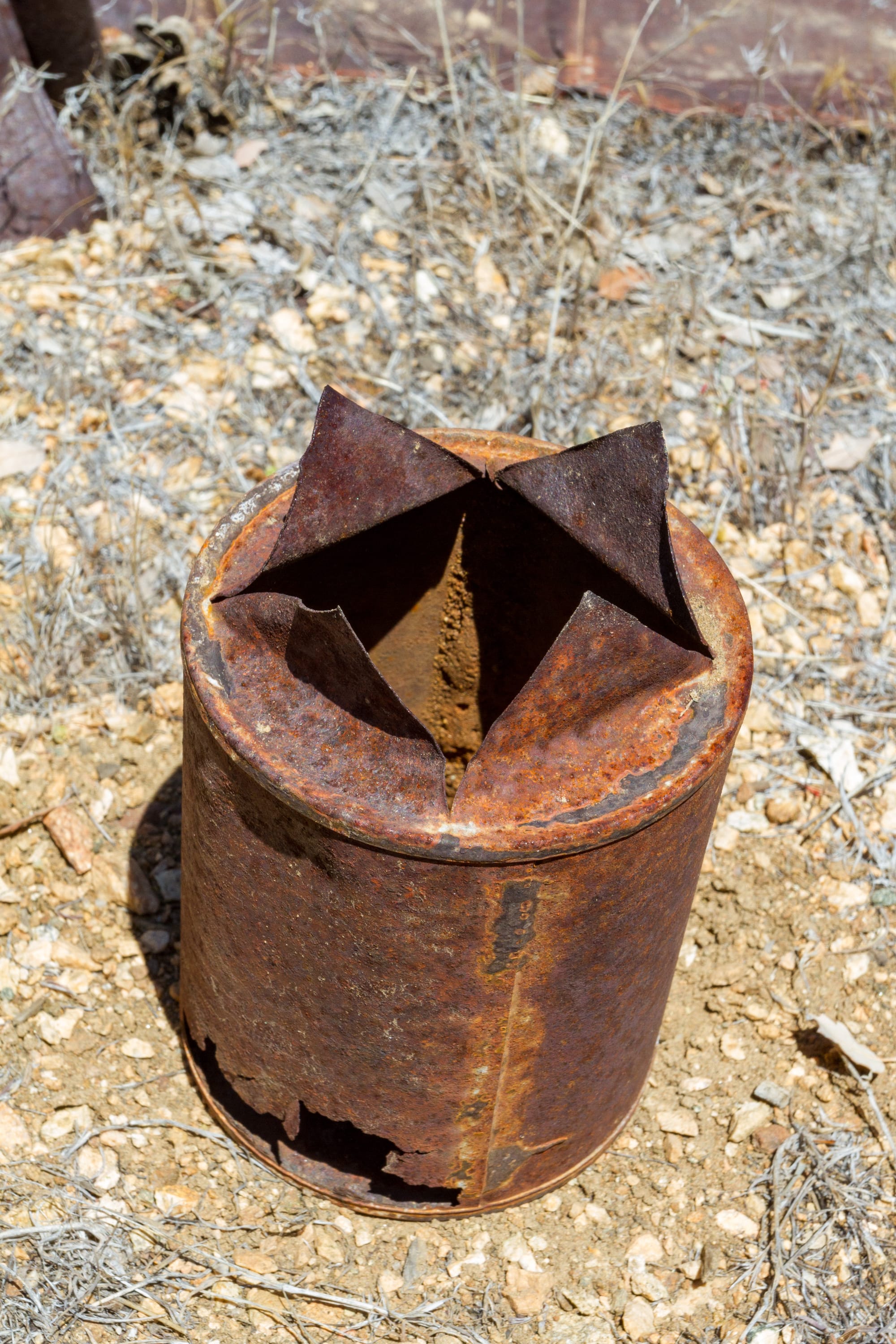
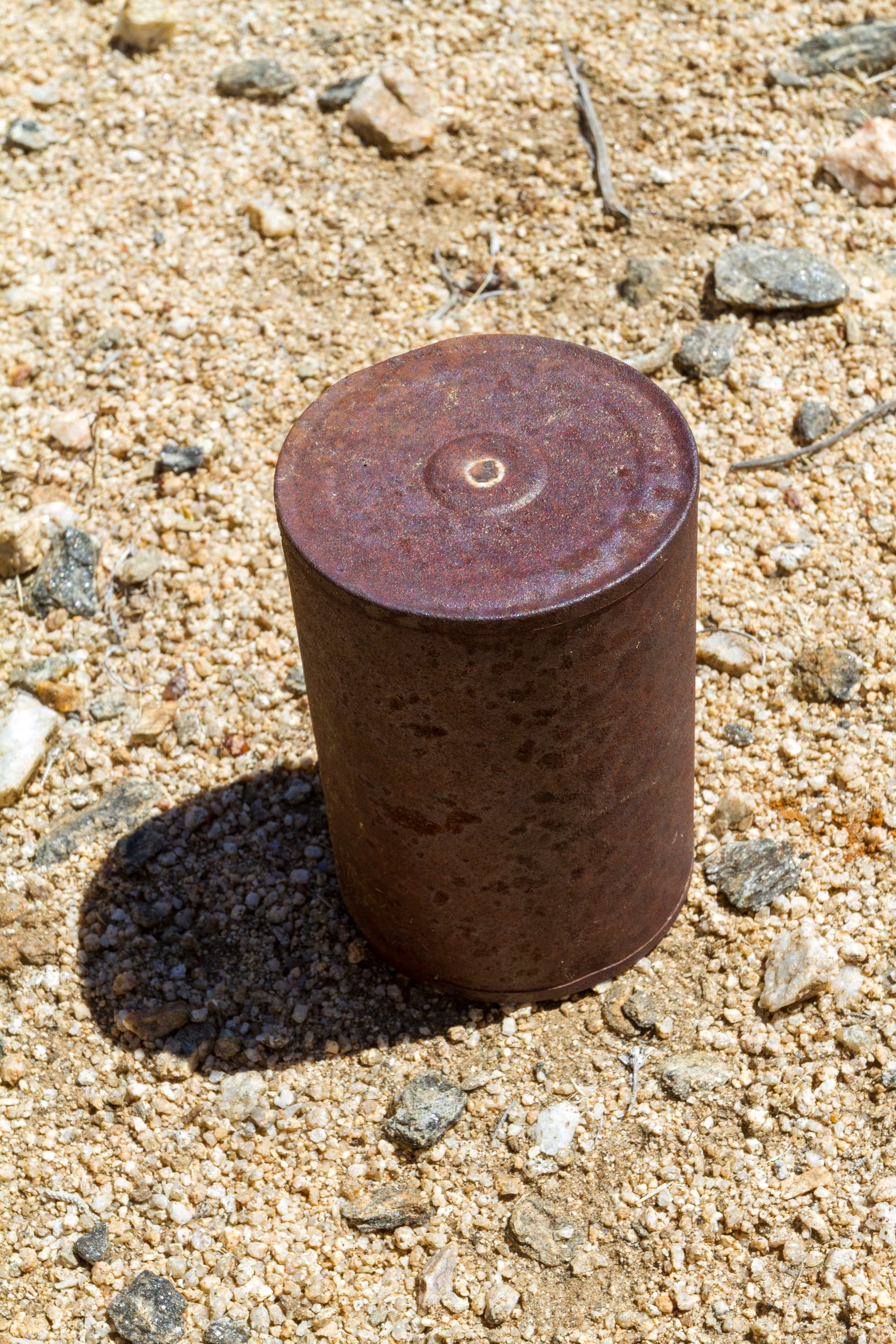
Left: Hole-in-cap side-soldered can. Center: Side-soldered can that contained fruit. Right: Hole-in-top can.
Canned food came west with the 1849 Gold Rush. Miners increasingly relied on it as they prospected deeper into the wilderness of the Sierra Nevada and beyond. Gail Borden first patented condensed milk in 1856. Henry Bessemer in England (1856) and William Kelly in the United States (1857) found how to convert cast iron into steel. It took time to reach the can: steel replaced iron in tinplate between 1875 and 1885. Steel needed a thinner coat of tin, which made cans cheaper. A folded, locking side seam was patented in 1859, but it was first used on powder kegs, then on lard and paint pails and on cans for dry goods such as baking powder and spices. On food cans, the lapped, soldered seam stayed the norm until the late 1880s. Around 1860, Louis Pasteur showed that bacteria cause most food spoilage, and that heating food in a sealed container kills them. That led to better canning methods. Keeping food from spoiling was also the aim behind many of the changes to the can itself, from the vent hole to tighter seams to the Sanitary can.
The food demands of the Civil War (1861 to 1865) greatly spurred technological innovations in machinery, which increased can production. Output rose from five million cans a year before the war to thirty million after it. The U.S. Government was purchasing enormous amounts of Borden's condensed milk for the Union army. In 1866, the first key-wind-opened sardine cans were produced. In 1883, the first machines capable of soldering the side seams of the cans were introduced, increasing can production. Before that the side seam was soldered by hand, in a thick, uneven bead that you can see was hand-done; it runs the full height of the can, right up to the ends. Machine solder is a thin, even line down the side seam that stops short of the top and bottom edges. Judge by the side seam, not the cap: caps were still soldered by hand for the most part, on milk cans as late as 1914.
In the late 1880s can makers began to fold and lock the side seam instead of lapping and soldering it, and by the mid-1890s the folded seam was general. The ends were still soldered on. Max Ams's firm in New York had been working on the European crimped can since 1888; Charles Ams patented a sealing compound in 1896, and in 1897 the firm's machine crimped the ends on with a double seam, the last step to the modern can.
The Sanitary Can Company, founded in 1904, brought an important series of innovations to canning. Their cans had "Open top" lids that were crimped onto the can without needing a vent hole in the lid. For the first time the ends were crimped on with no solder at all, and the cans were completely machine-made. The folded side seam was still sealed with a thin film of solder on the outside, but it does not show the way the old hand solder does, so in the field the can looks solderless. The Open top style cans also have the advantage of being fully open for filling at the factory and air-tight after heating and sealing. The name "Sanitary" was embossed on one end of the can. The company itself lasted only until 1908, when the American Can Company absorbed it, and the mark is usually dated 1904 to 1908, but cans carrying it have turned up at a site of 1915 to 1921, so it was used a while longer. However, the new Open top or Sanitary style remained. The modern cans we have today are close variants of this style.
After 1904, most food cans switched to this modern style. Sanitary cans were the majority of cans made by 1911, and by the early 1920s they had almost completely replaced the old soldered cans. Hole-in-cap cans on a site point to occupation before about 1920, and a site with nothing but hole-in-cap cans probably dates from before 1904. Milk was the exception.
Evaporated milk was first canned in the U.S. in 1885 by the Helvetia Milk Condensing Company, in hole-in-cap cans with a small cap. Around 1900 the hole-in-top can appeared. It has no cap, only a small dot of solder in the center of one end, sealing the hole the can was filled and vented through.
Evaporated milk was one of the first products packed this way, and milk canners stayed its biggest users, but the same solder dot turns up on condensed milk cans, on the base of vacuum-packed coffee cans, and on later tapered meat tins. Cans were often turned over before labeling, so the dot may be on either end. Milk cans of this type were opened by punching two holes on opposite sides of the lid.
Tobacco tins turn up at nearly every old mining camp and ghost town. Most held pipe tobacco: the flat pocket tin from 1892, the upright pocket tin (Prince Albert and others) from 1907 or 1908, and the lunch-box tin, made from 1901 to 1925 and kept for carrying lunch. Chewing tobacco and snuff came in flat round tins like today's. Where a paper tax stamp survives, its date dates the tin.
Simplified food can style guide
(Years are as close as possible and are approximate; there was overlap)
- Until 1847, cans were made completely by hand
Ends and caps
- Hole-and-cap cans (cap with no vent hole): 1810s to the 1850s
- Hole-in-cap cans (vent hole in the cap): from 1823, the norm from the 1850s to 1904, scarce by the early 1920s, last made around World War II
- Hole-in-top (vent hole) cans: about 1900 to the 1980s. While other foods moved to the Sanitary can, milk moved to this one.
- Crimped-on can ends: from 1897
- Sanitary can ("Sanitary" embossed on one end): 1904 to 1908, possibly to about 1920
- Open top (modern) cans, ends crimped on, no visible solder: 1904 to present. Most cans by 1911, nearly all by the early 1920s.
Side seams and solder
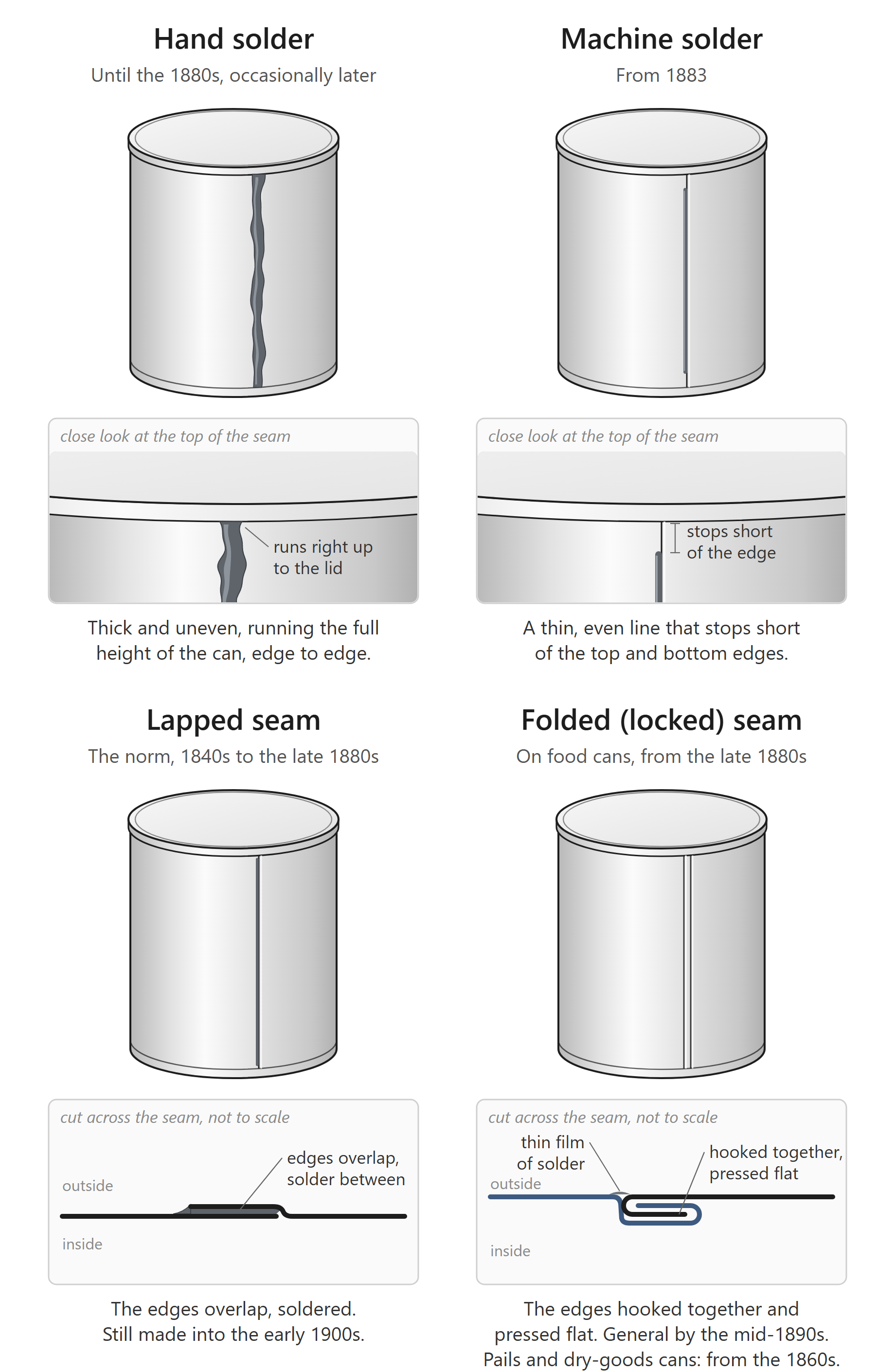
- Thick, uneven hand solder on the side seam, running edge to edge: until the 1880s, occasionally later
- Thin, even machine solder on the side seam, stopping short of the top and bottom edges: from 1883
- Lapped, soldered side seams: the norm from the 1840s to the late 1880s, still made into the early 1900s
- Folded (locked) side seams on food cans: from the late 1880s, general by the mid-1890s
Other cans
- Folded (locked) side seams on lard pails, paint pails, and dry-goods cans such as baking powder and spice: from the 1860s (patented 1859)
- Flat pocket tobacco tins (slim, curved, roughly square, hinged lid): from 1892
- Prince Albert upright pocket tins (tall, oval, hinged lid on top): 1907 to 1988
- Key-wind opening: patented 1866, little used until 1895
- Log Cabin shaped can: 1897 to 1955 (none made 1942 to 1948)
- Hills Brothers first vacuum-packs coffee: 1900; key-wind opening on the can from 1903
- Tuna first canned in California: 1909
- Key-opening collar can for coffee: starting in 1917
- Canned citrus juice first shipped from Florida: 1921
- Canned ham: starting in 1926
- Canned beer (enamel interior): first appeared in 1935
- Cone-top beer cans: 1935 to 1959, mostly gone by the mid-1950s. Flat bottom before 1937, concave after. (Cone-top oil cans ran into the 1980s.)
- Beer cans marked "Internal Revenue Tax Paid": June 1935 to March 1950. Olive-drab cans marked "Withdrawn Free of Tax for Exportation": military, 1942 to 1947.
- Aerosol cans: starting in 1945
- Soft drink cans: 1953. The first were cone-tops, but nearly all soda companies had switched to flat tops by the end of 1954, so a cone-top soda can most likely dates from 1953 or 1954.
- All-aluminum beer cans: 1959; 12-ounce cans from 1963
- Pull-tab can: by 1962
- Stay-on tabs: mid-1970s. Pull-tab cans were still made until 1983.
Bottles
An in-depth guide to bottle dating is far beyond our scope here. It is an extensive topic with many exceptions and complexities. What follows is only a very simple guide to bottles in the American West. It's important to note that these dates are general guidelines and there can be significant overlap and regional variations. No glass was made in the West before 1859, so the earliest bottles here were shipped in from the East or from Europe. San Francisco's glass houses were still turning out crude black glass bottles as late as 1880, so an old-looking bottle in the West can be younger than it looks. As with cans, a bottle's date is a floor, not a ceiling, and more so than for cans: bottles were refilled and reused for years, though many of the beer and liquor bottles that reached a mining camp full were thrown away when empty.
Bottle Seams, Lips, and Bases
(Check the lip first, then the base, then the body.)
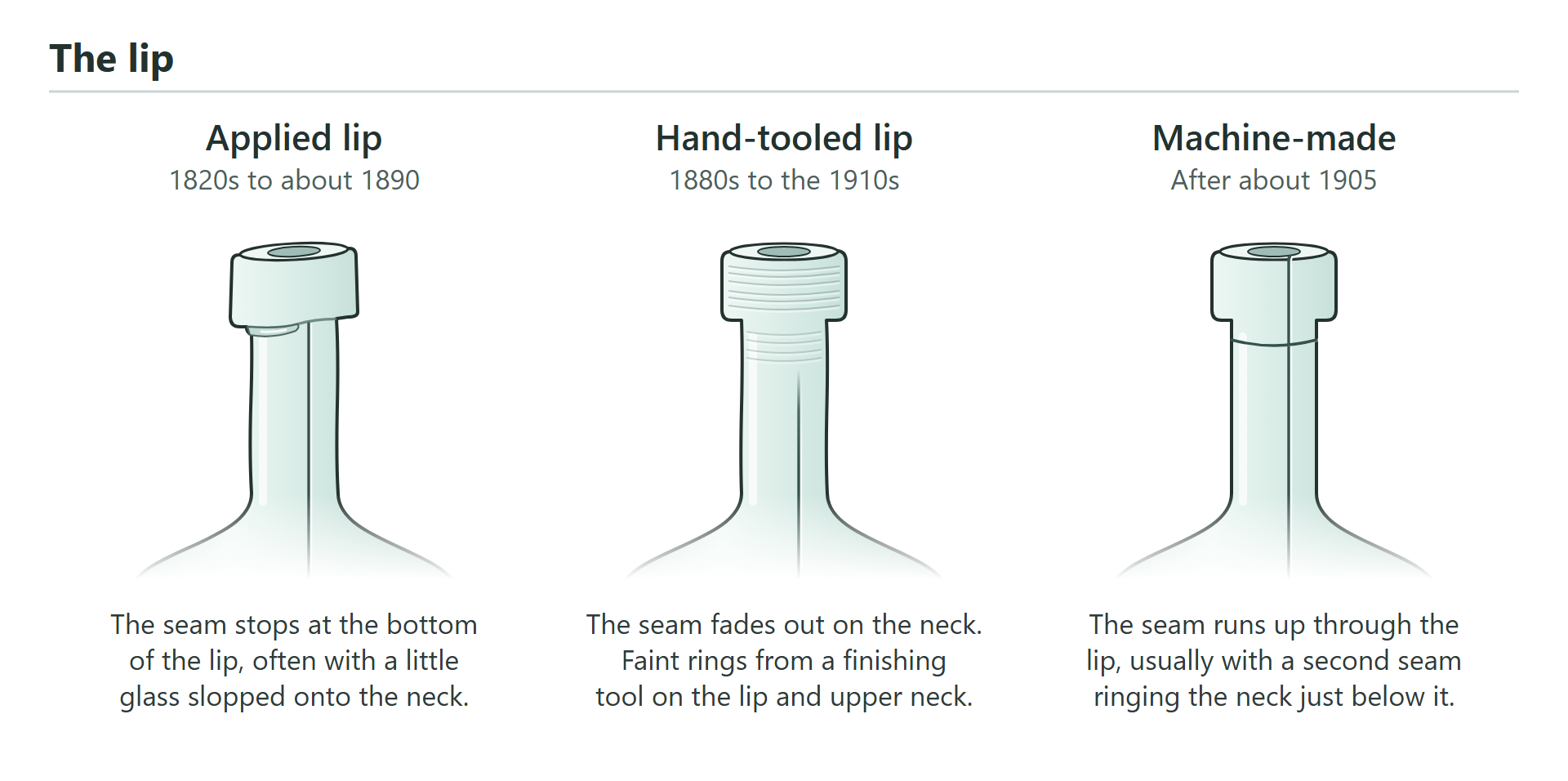
- Seam stops short at the bottom of the lip, often with a little glass slopped over onto the neck where the lip was added as a separate ring of glass: applied lip, 1820s to about 1890 (beer bottles into the 1890s).
- Seam fades out on the neck below the lip, and the lip and upper neck carry faint horizontal rings from a finishing tool: hand-tooled lip, 1880s to the 1910s (small drugstore bottles from the 1870s).
- Seam runs up through the lip, usually with a second seam ringing the neck just below it: machine-made, after about 1905 (a few wide-mouth jars from the mid-1890s), and nearly every bottle by 1920. Milk bottles are the exception: machine-made ones often have side seams that fade out on the neck, but they carry the small valve mark on the base described below.
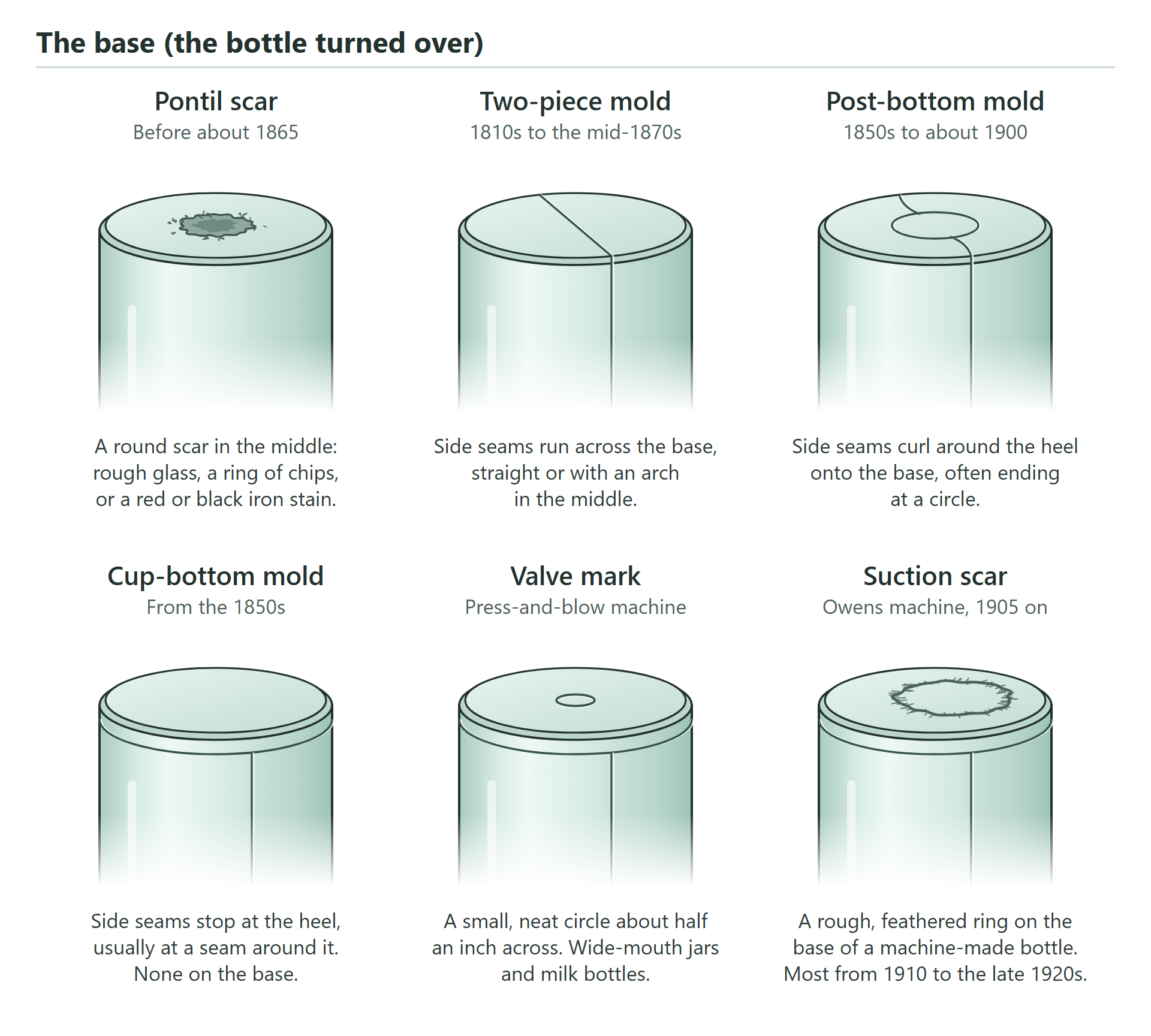
- A round scar in the middle of the base, where a rod held the bottle while the lip was made (rough glass, a ring of chips, or a red or black iron stain): pontil scar, before about 1865, nearly always before the early 1870s. Fancy bottles, such as barber and perfume bottles, had them later.
- Side seams run across the base, straight or with an arch in the middle: two-piece mold, 1810s to the mid-1870s (later only on round-bottomed "torpedo" soda bottles).
- Side seams curl around the heel onto the base, often ending at a circle: post-bottom mold, 1850s to about 1900; beer and soda bottles and fruit jars to about 1905, a few later.
- Side seams stop at the heel, usually at a seam running around it, with none on the base: cup-bottom mold, from the 1850s, the usual mold from the late 1880s to the 1910s, and on nearly all machine-made bottles since.
- A ring on the base of a machine-made bottle: a rough, feathered one is the Owens machine's suction scar, 1905 on, most of them 1910 to the late 1920s; a smooth one can be from any machine, to the present. A small, neat circle about half an inch across is the valve mark of a press-and-blow machine, on wide-mouth jars and milk bottles.
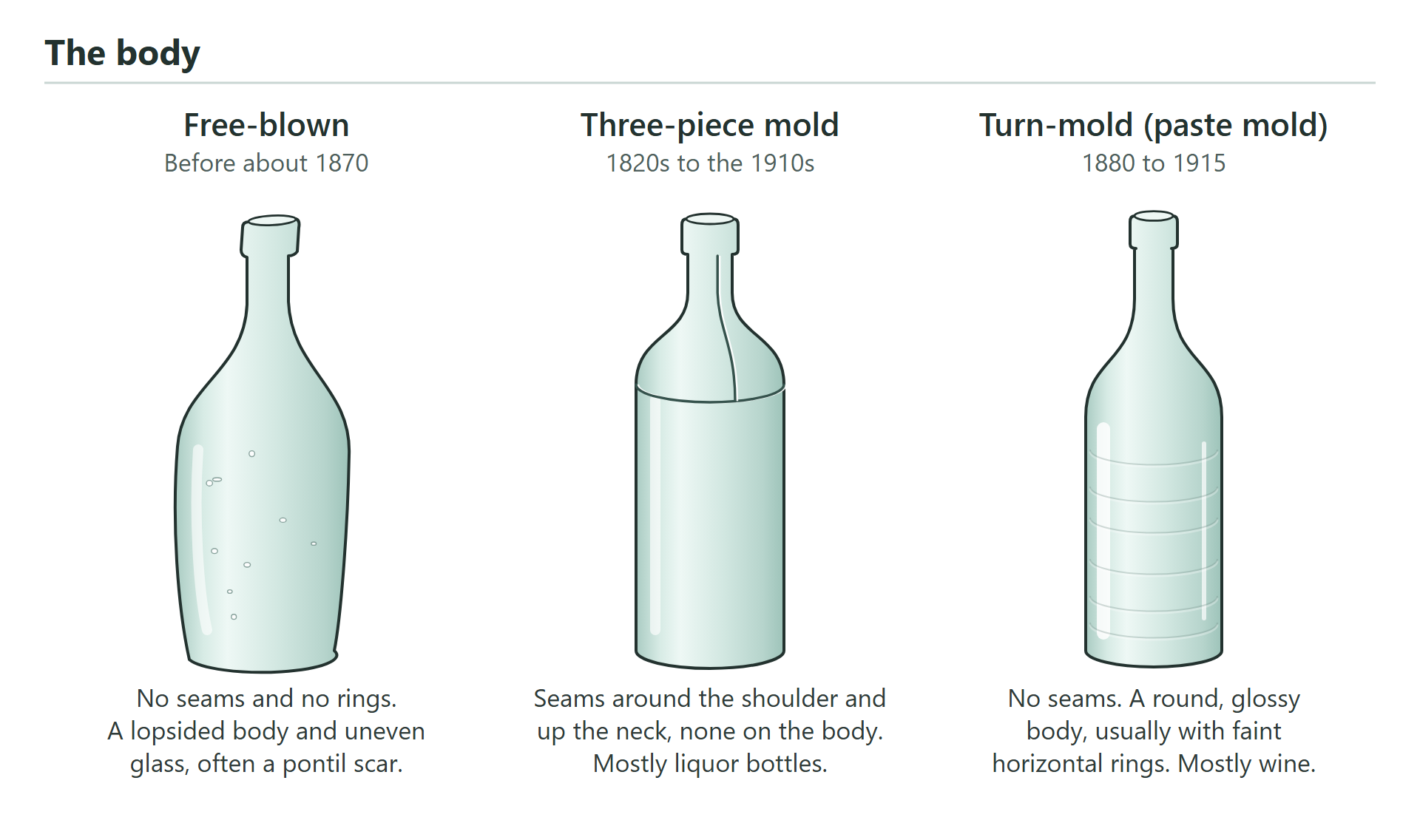
- No seams and no rings, often with a pontil scar: free-blown (a lopsided body and uneven glass) or dip-molded (an even body, sometimes with a faint line where it meets a hand-shaped shoulder), before about 1870, most before the Civil War.
- Seams around the shoulder and up the neck, none on the body: three-piece mold, 1820s to the 1910s, mostly liquor bottles. With an applied lip it is from before about 1890; with a tooled lip, from the 1890s to the 1910s.
- No seams, a round body, and a glossy surface, usually with faint horizontal rings: turn-mold (paste mold), 1880 to 1915, a few from the 1860s to the early 1920s. Mostly wine and champagne bottles, also liquor and beer; never embossed on the body.
Bottle Closures
- Cork: the usual stopper on most bottles into the 1920s, so a lip made for a cork does not date a bottle by itself. Medicine, food, and most liquor bottles moved to screw caps between the 1920s and the mid-1930s; wine kept its cork.
- Hutchinson stopper (a wire loop sticking up out of a soda bottle's short neck, holding a rubber disc inside): 1879 to the mid-1910s, most from the late 1880s to 1912.
- Crown cap (the metal beer and soda cap, crimped over a narrow ring at the top of the lip): patented 1892, nearly all after about 1895, and the usual beer and soda cap by the mid-1910s.
- Screw threads on the outside of the lip: canning jars from 1858; on other bottles, common once the threads were standardized between 1919 and 1924, and likely the most common closure by the late 1920s.
Bottle Embossing and Labels
- Embossed names, places, and products on the body: mostly 1850s to 1910s. Embossing carried on after that on machine-made milk, soda, and liquor bottles and on bottle bases, so read the seams first, then the words: a name can be looked up.
- A maker's mark on the base dates a bottle to the years its glass company used that mark, and most can be looked up on the Society for Historical Archaeology's bottle website or David Whitten's Glass Bottle Marks website. The commonest, Owens-Illinois's I inside an oval laid over a diamond, began in 1929; the diamond was dropped from 1954, though some plants kept it into the 1960s. The number to the right of the mark is a date code, usually the last one or two digits of the year, and "Duraglas" in script, often with the mark, dates from 1940 to 1964.
- Embossed "Federal Law Forbids Sale or Re-use of This Bottle": liquor bottles, 1935 to 1964, a few years longer on old molds.
- "No Deposit, No Return": a throwaway bottle, made to be used once. Throwaway beer bottles came in during the mid-1930s and throwaway soda bottles in 1948.
- Lettering painted on and baked into the glass, on soda and milk bottles: from the early 1930s, common by 1935, and in time it replaced embossing on most of them.
Bottle Color
- "Black" glass (very dark olive green or amber, thick, and black until held up to the light): mostly before about 1880, imported bottles into the 1890s. Liquor, ale, porter, and wine.
- Amethyst or purple (clear glass the sun has turned): about 1880 to 1920, a few to the early 1930s. Any depth of purple counts, down to a faint lavender.
- Colorless or clear: uncommon before the 1870s, growing from about 1880, and common after machines took over in the 1910s. Hold a thick piece to the light: a lavender tint means manganese, before about 1920; a straw or honey tint means selenium, about 1915 to the 1950s; no tint at all is usually later still.
- Aqua (pale blue-green, the natural color of bottle glass): 1800s to 1930s, very common before the 1920s; sodas and fruit jars stayed aqua longest.
- Cobalt blue: any date, never common. Sodas and inks from the 1840s; a little more common on poison and cosmetic bottles.
- Green and amber: any date. Olive green is mostly 1800s, except on wine and champagne bottles, which are still made in it. Most beer bottles have been amber since the last quarter of the 1800s.
- Milk glass (opaque white): after about 1870. Cosmetic bottles to about 1920; cold cream and ointment jars from the 1890s to about the 1950s.
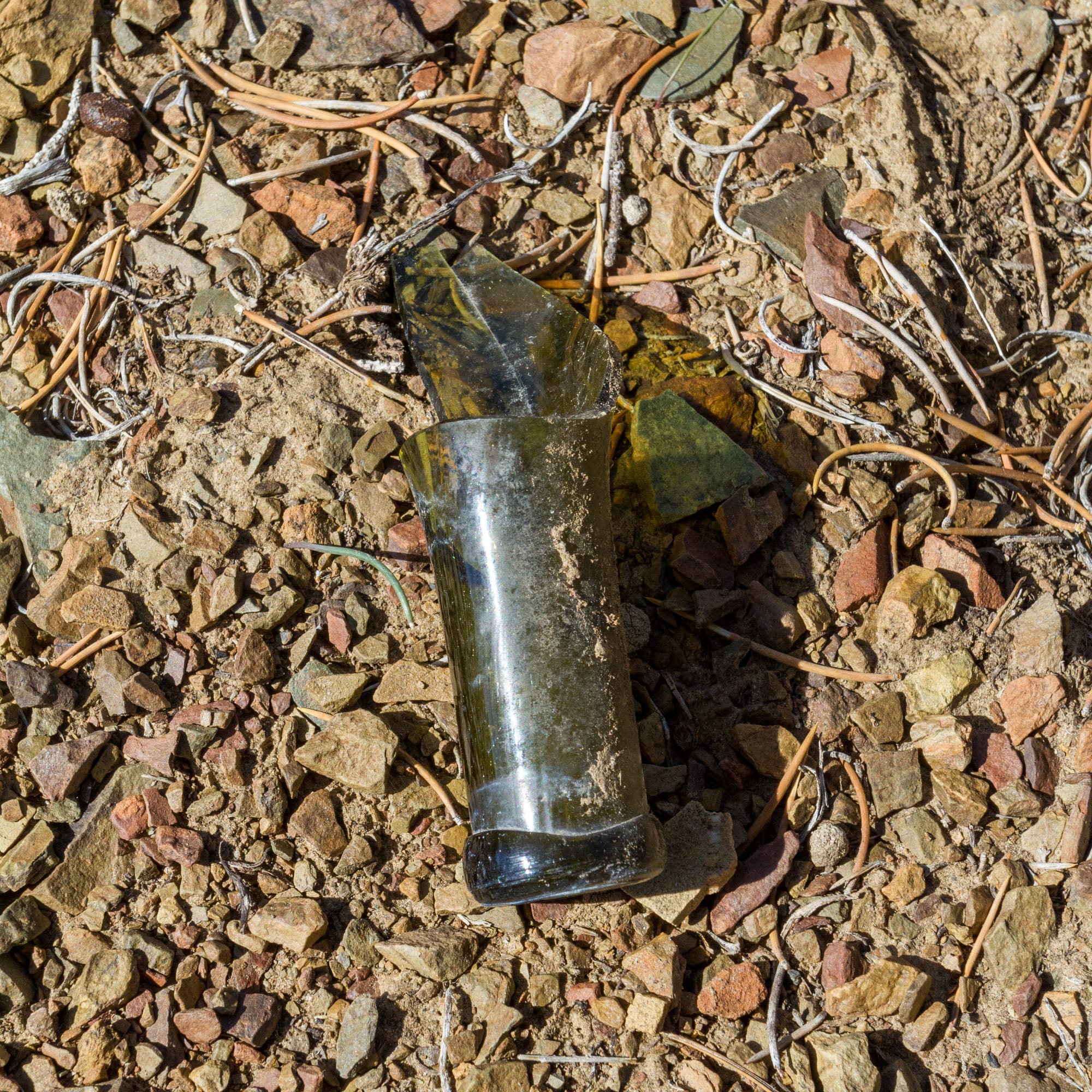
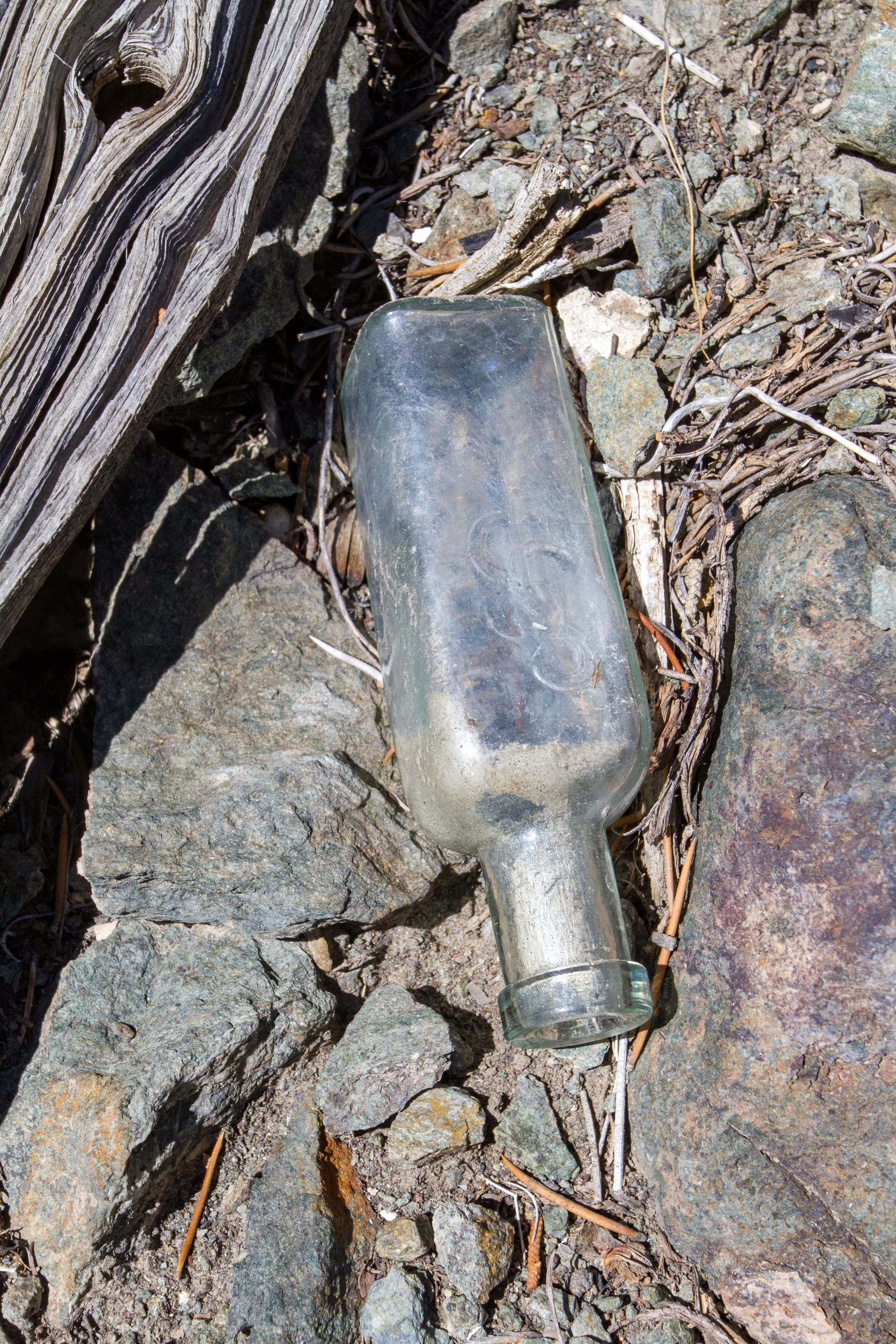
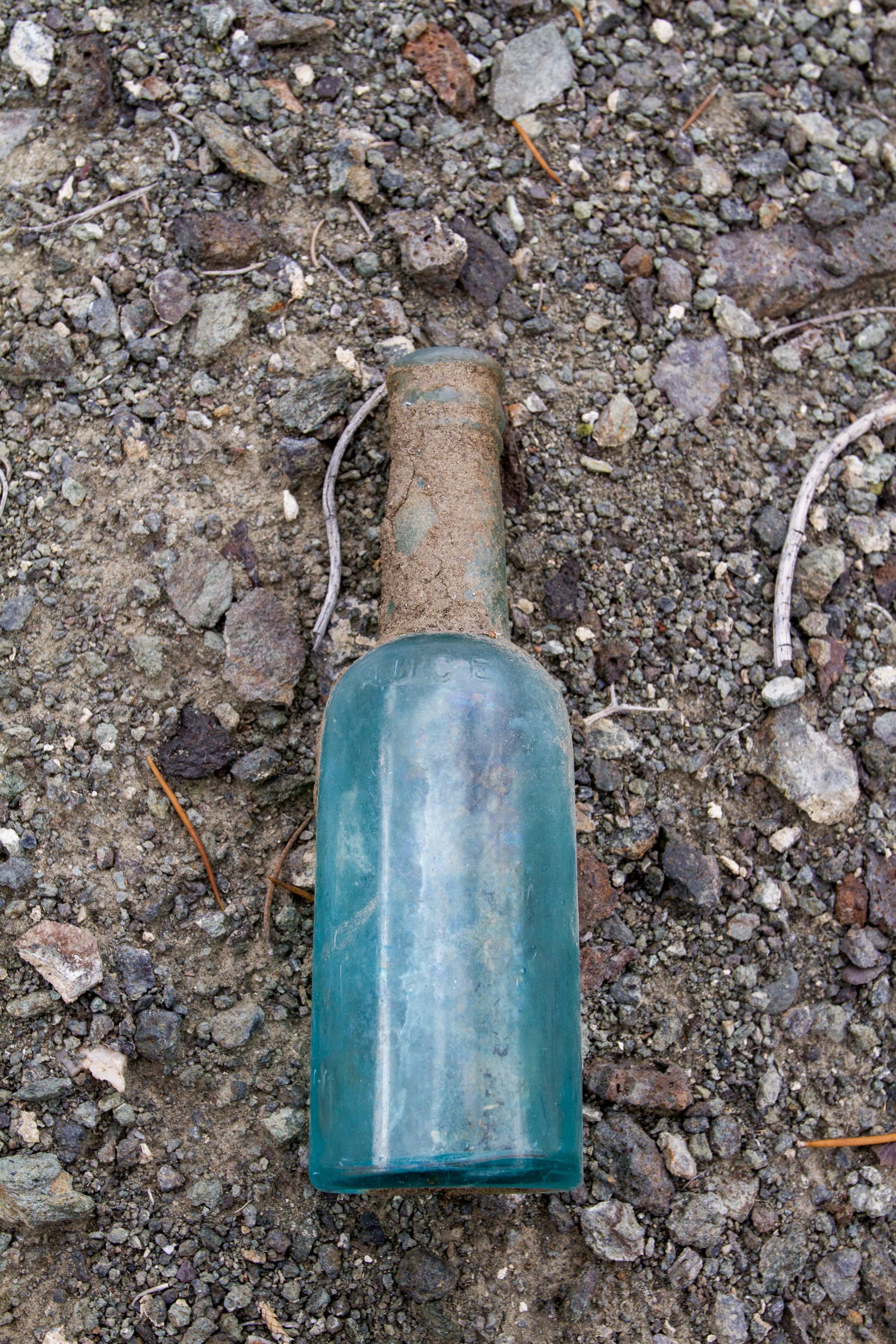
L: Neck from a dark green handmade bottle. C: clear bottle. R: Aqua bottle.
During Prohibition, 1920 to 1933, few bottles were made for alcoholic drinks, and old ones were refilled; an American liquor bottle that is mouth-blown almost always predates it. As with cans, judge a site by the mix, not by one bottle.
Nails
Perhaps surprisingly, nails can also be useful for dating historic sites. The earliest nails were hand-wrought nails, which were hand-made one at a time by a blacksmith from square or rectangular iron rods. They would heat the end of the rod in a forge, hammer it to a point, and cut the nail off the rod. The nails taper to a point on all sides. The head was created by pounding the other end in a "nail header," which flattened out the end. These nails are rough and irregular and will show their craftsmanship.
As early as the 1790s, simple machines came into use to increase the production of nails. Cutting machines sheared nails off the end of a thin strip of iron plate, as wide as the nail was long. These are the "square" nails of old buildings, flat-sided rather than round, though usually wider one way than the other. They have straight edges on all sides and taper on two sides to an end but without a point. Early square-cut nails often have irregular heads created by hammer strikes. After around 1830, these nail heads were machine-made and became more uniform. It is worth noting that square-cut nails are still made today, but only for specialty uses and in very low quantities.
Steel came to the nail in the 1880s, a little later than to the can. In that decade nail makers began switching from iron to steel, and the wire nail, made from cheap steel wire, began to compete with the cut nail. The steel wire nails that are common today quickly became dominant: they were about 7 percent of the nails made in the U.S. in 1886, more than half in 1892, and more than 80 percent by 1897.
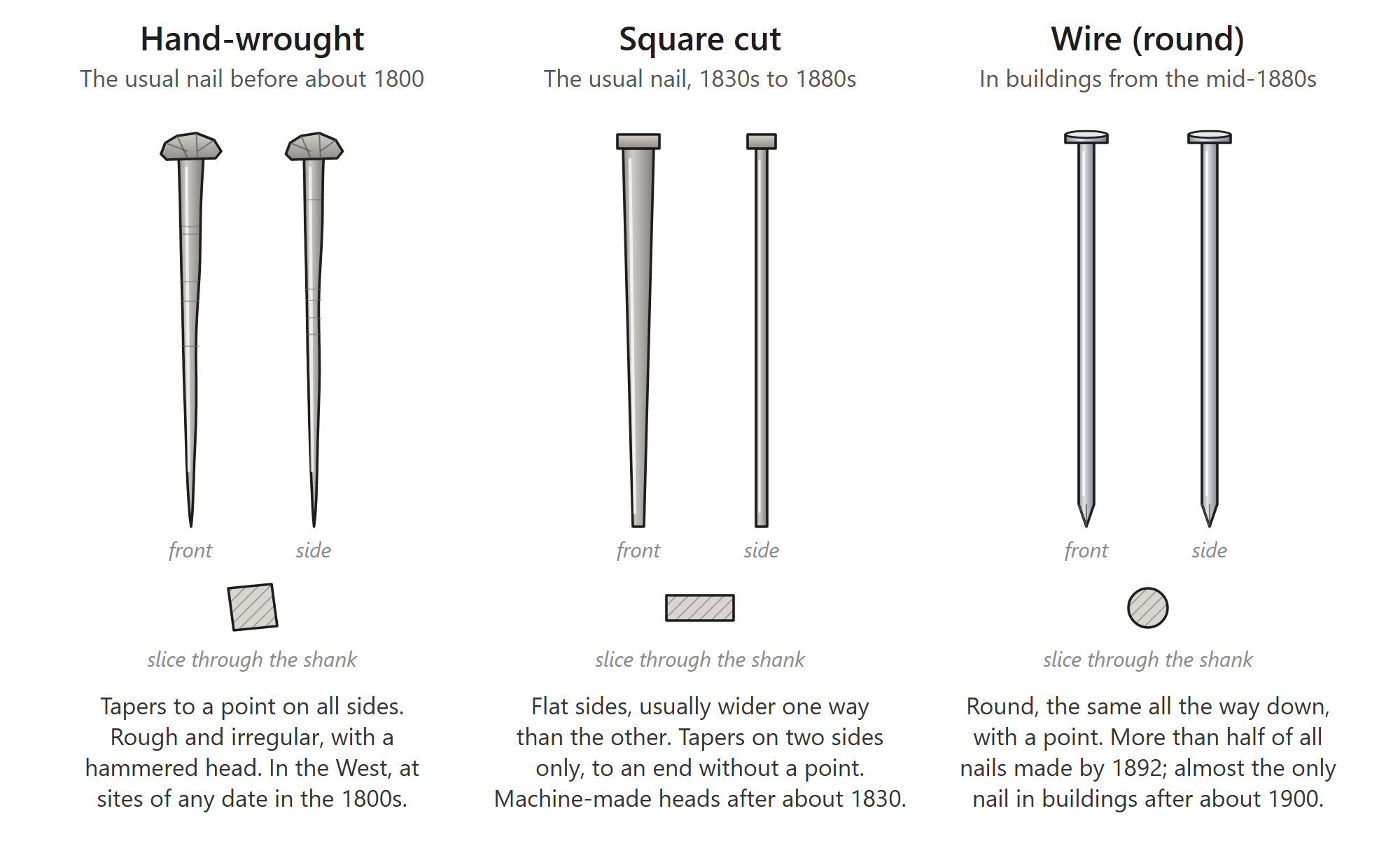
A basic summary of the chronology of nails:
- Hand-wrought nails: the usual nail before about 1800, and uncommon in the settled East after the 1820s. In the West they turn up at sites of any date in the 1800s, made by a blacksmith or for a special job, so one does not by itself mean an early site.
- Square cut nails: from the 1790s; the usual nail from the 1830s through the 1880s; under half of all nails made from 1892 on, and rare in buildings put up after about 1900, except in floors and where wood meets concrete.
- Wire (round) nails: a few from the 1850s, in small boxes and crates; in buildings from the mid-1880s; more than half of all nails made by 1892; almost the only nail in buildings after about 1900.
As with cans and bottles, judge a site by its nails as a group, not by one. Nails are a good clue to when a building went up, because they went in when it was built. But repairs add newer nails, most often in the roof, the shingles, and the door and window frames, so look at the framing and the corners for the builder's own. Salvaged lumber can bring older nails with it. And don't read a date straight off the factory figures above: builders kept using cut nails for years after the factories switched, and every repair added the newer kind, so a building is usually older than its share of wire nails suggests, often by ten years or more.
References
Cans
American Can Company, The Canned Food Reference Manual, 2nd ed., American Can Company, New York, 1943.
Busch, Jane, "An Introduction to the Tin Can," Historical Archaeology, v.15, no. 1, 1981.
Collins, James H., The Story of Canned Foods, E. P. Dutton & Company, New York, 1924.
Hunziker, Otto F., Condensed Milk and Milk Powder, published by the author, LaFayette, Indiana, 1914.
IMACS User's Guide, section 471, "Tin Cans," University of Utah, August 2001.
Jim Rock Historic Can Collection, Southern Oregon University, https://libguides.sou.edu/soda/cans/home.
Lanford, Steve, and Robin Mills, Hills Bros. Coffee Can Chronology Field Guide, Open File Report 109, Bureau of Land Management, Fairbanks, Alaska, 2006.
Maxwell, D. B. S., "Beer Cans: A Guide for the Archaeologist," Historical Archaeology, v.27, no. 1, 1993.
Merritt, Christopher W., Historic Artifact Guide, Utah Division of State History, Salt Lake City, 2014.
Rock, James T., "Cans in the Countryside," Historical Archaeology, v.18, no. 2, 1984.
Rock, Jim, A Brief Commentary on Cans, 1987, facsimile by Coyote Press, Salinas, California.
Rock, Jim, Tin Canisters: Their Identification, manuscript on file, U.S. Forest Service, Klamath National Forest, Yreka, California, 1989.
Rock, Jim, Can Chronology, 1993, facsimile by Coyote Press, Salinas, California.
Sagstetter, Beth, and Bill Sagstetter, The Mining Camps Speak: A New Way to Explore the Ghost Towns of the American West, BenchMark Publishing of Colorado, Denver, 1998.
Twitty, Eric, Riches to Rust: A Guide to Mining in the Old West, Western Reflections Publishing Company, Montrose, Colorado, 2002.
Bottles
Berge, Dale L., Simpson Springs Station: Historical Archaeology in Western Utah, Cultural Resource Monograph 6, Bureau of Land Management, Utah State Office, 1980.
Busch, Jane, "Second Time Around: A Look at Bottle Reuse," Historical Archaeology, v.21, no. 1, 1987.
Hardesty, Donald L., Mining Archaeology in the American West: A View from the Silver State, University of Nebraska Press and the Society for Historical Archaeology, Lincoln, 2010.
IMACS User's Guide, section 472, "Bottles/Glass," University of Utah, June 1992.
Lindsey, Bill, Historic Glass Bottle Identification & Information Website, Society for Historical Archaeology and Bureau of Land Management, https://sha.org/bottle/, including its articles by Bill Lockhart and others on glass makers' marks.
Lockhart, Bill, "The Color Purple: Dating Solarized Amethyst Container Glass," Historical Archaeology, v.40, no. 2, 2006.
McDougall, Dennis P., "The Bottles of the Hoff Store Site," in Allen G. Pastron and Eugene M. Hattori, eds., The Hoff Store Site and Gold Rush Merchandise from San Francisco, California, Special Publication Series 7, Society for Historical Archaeology, 1990.
Merritt, Christopher W., Historic Artifact Guide, Utah Division of State History, Salt Lake City, 2014.
Twitty, Eric, Riches to Rust: A Guide to Mining in the Old West, Western Reflections Publishing Company, Montrose, Colorado, 2002.
Nails
Adams, William Hampton, "Machine Cut Nails and Wire Nails: American Production and Use for Dating 19th-Century and Early-20th-Century Sites," Historical Archaeology, v.36, no. 4, 2002.
CAL FIRE Archaeology Program, "Miscellaneous Artifacts," web page, California Department of Forestry and Fire Protection.
Hardesty, Donald L., The Pony Express in Central Nevada: Archaeological and Documentary Perspectives, Cultural Resource Series 1, Bureau of Land Management, Nevada State Office, Reno, 1979.
Hardesty, Donald L., Mining Archaeology in the American West: A View from the Silver State, University of Nebraska Press and the Society for Historical Archaeology, Lincoln, 2010.
Hattori, Eugene M., and Bridgette M. Brigham, "Construction Hardware from Gold Rush San Francisco," in Allen G. Pastron and Eugene M. Hattori, eds., The Hoff Store Site and Gold Rush Merchandise from San Francisco, California, Special Publication Series 7, Society for Historical Archaeology, 1990.
IMACS User's Guide, section 470, "Nails," University of Utah, August 2001.
Luney, Frank Solon, Wire Nail Making in America, thesis for the degree of Mechanical Engineer, University of Illinois, 1921.
Merritt, Christopher W., Historic Artifact Guide, Utah Division of State History, Salt Lake City, 2014.
Wells, Tom, "Nail Chronology: The Use of Technologically Derived Features," Historical Archaeology, v.32, no. 2, 1998.
Part of the Field Reference Guides