Bourke Lee wrote in the 1930s: "There is a Lost Burro Mine on almost every mountain." Prospectors spent so much time chasing their wandering burros through the desert hills that the animals became their best prospecting partners. The Lost Burro in the Cottonwood Mountains of northern Death Valley earned its name the same way, but unlike most of the stories, this one paid off.
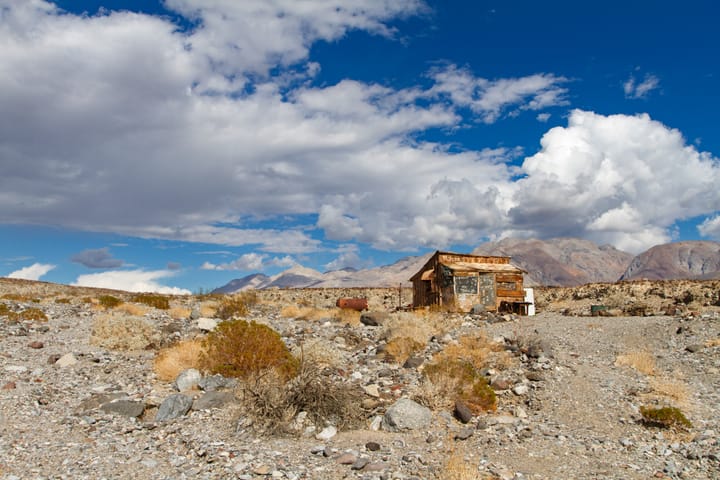
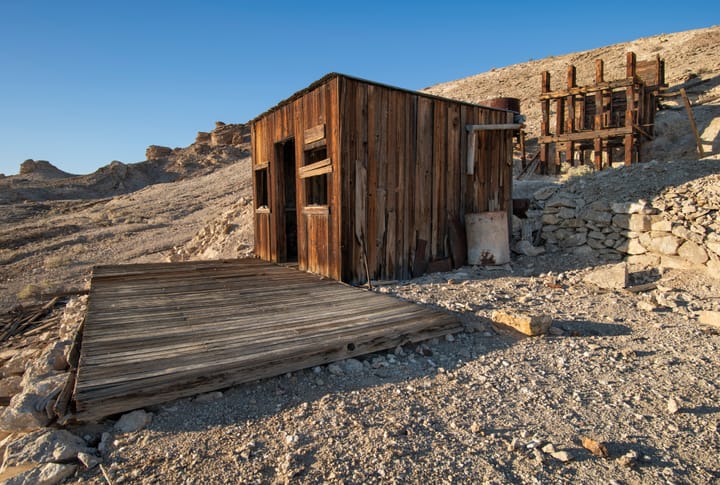
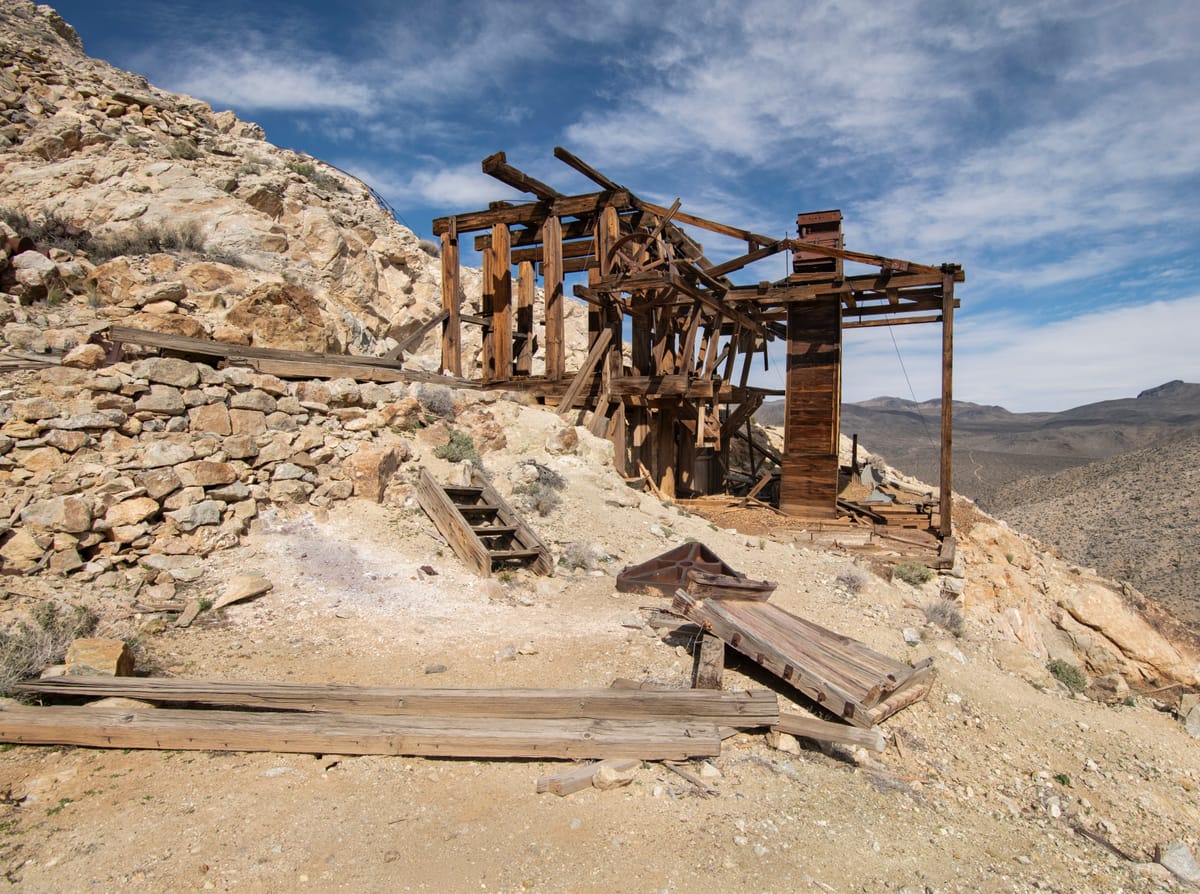
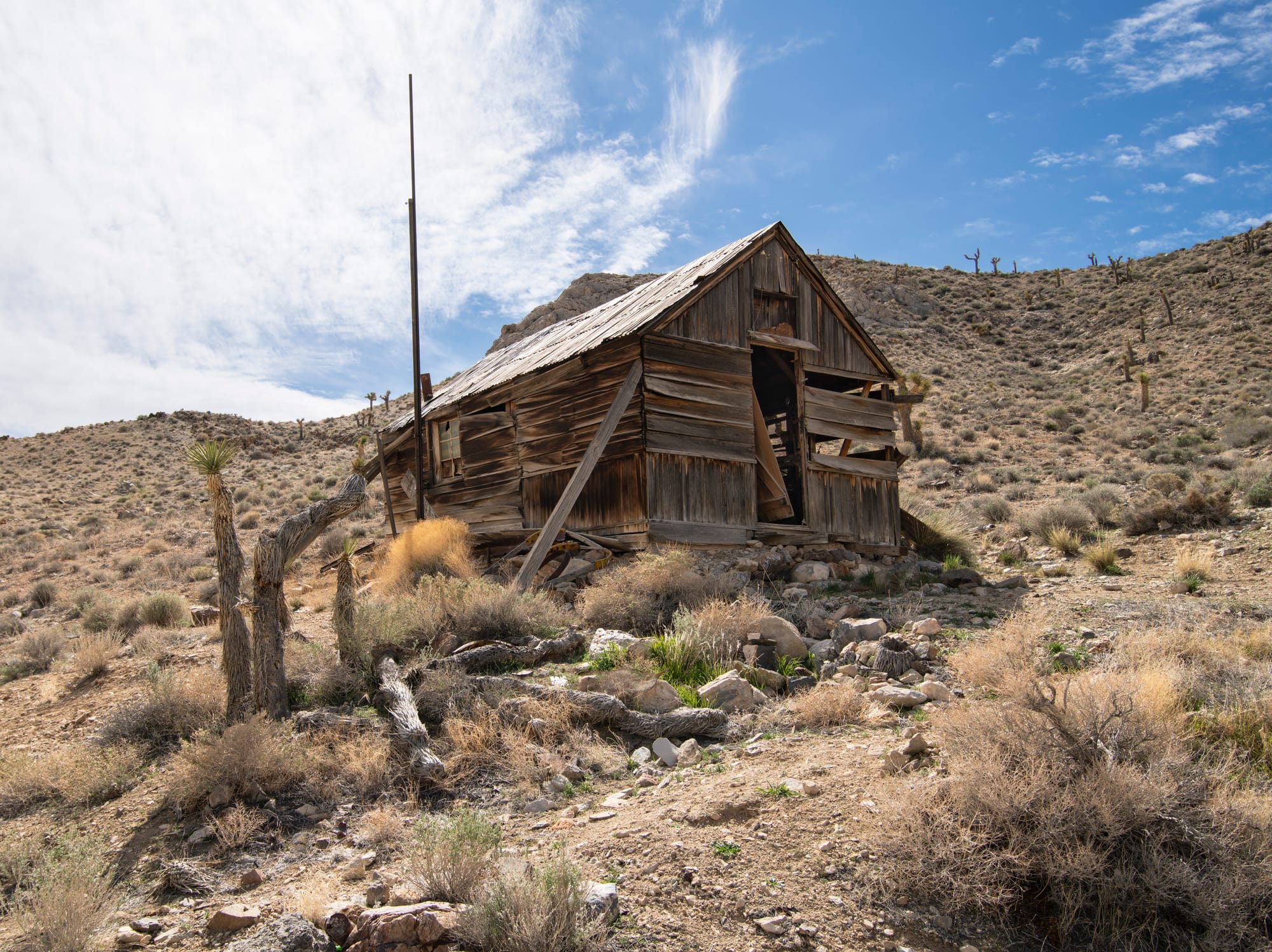
The Lost Burro is the only gold mine in the Ubehebe District, a region otherwise known for lead, copper, and silver. It sits in a narrow canyon on the range between Hidden Valley and Racetrack Valley, reached by a rough 4WD spur off the Hidden Valley road. The cabin is falling apart and only a skeleton of the stamp mill still remains above it, but the site is well worth the drive.
History
In April 1907, a prospector named Bert Shively picked up a rock to throw at his stray burros and its weight made him take a closer look. It was laced with free gold. Shively had worked a lease on Ladd Mountain in Rhyolite, so he knew what he was looking at. He filed on six claims with surface assays running from $40 to $1,000 per ton. His partners were W.D. Blackmer and Charles N. Garden of the Tramp Consolidated, W.B. Morris of the Bullfrog Mining Company, and Jack McCormick.
What followed was a dizzying series of ownership changes. The discoverers bonded the property for $45,000 to a Beatty group, who passed it as a $50,000 bond to Thomas Cornish of Denver and H.B. Lind of Goldfield. Then Cornish died. Lind, hospitalized at the time, missed his payment deadline and was denied an extension. The property reverted to the original owners. By October 1907, ore was averaging $80.86 per ton with at least $50,000 worth in sight.
The depression of 1907 didn't halt work. By spring 1908, Goldfield Consolidated acquired the property for $35,000, drawn by assays up to $1,450 per ton. It sold again in 1909 for $40,000. The property changed hands or came under option at least five times in three years. Everybody wanted the Lost Burro, but nobody could hold onto it.
Around 1915, the Montana-Tonopah Company secured the property on a lease and bond, planning to do what no one else had managed: build a mill. They shipped a fifty-ton five-stamp mill from Bonnie Claire. Trucks hauled the machinery the first thirty miles from the railhead, and a Caterpillar tractor, crawling at three miles per hour, handled the last twenty-two. Water was piped from Burro Spring and Rest Spring on Tin Mountain, about seven and a half miles northeast. Sections of the pipeline are still visible along the White Top Mountain Road and at the mine site.
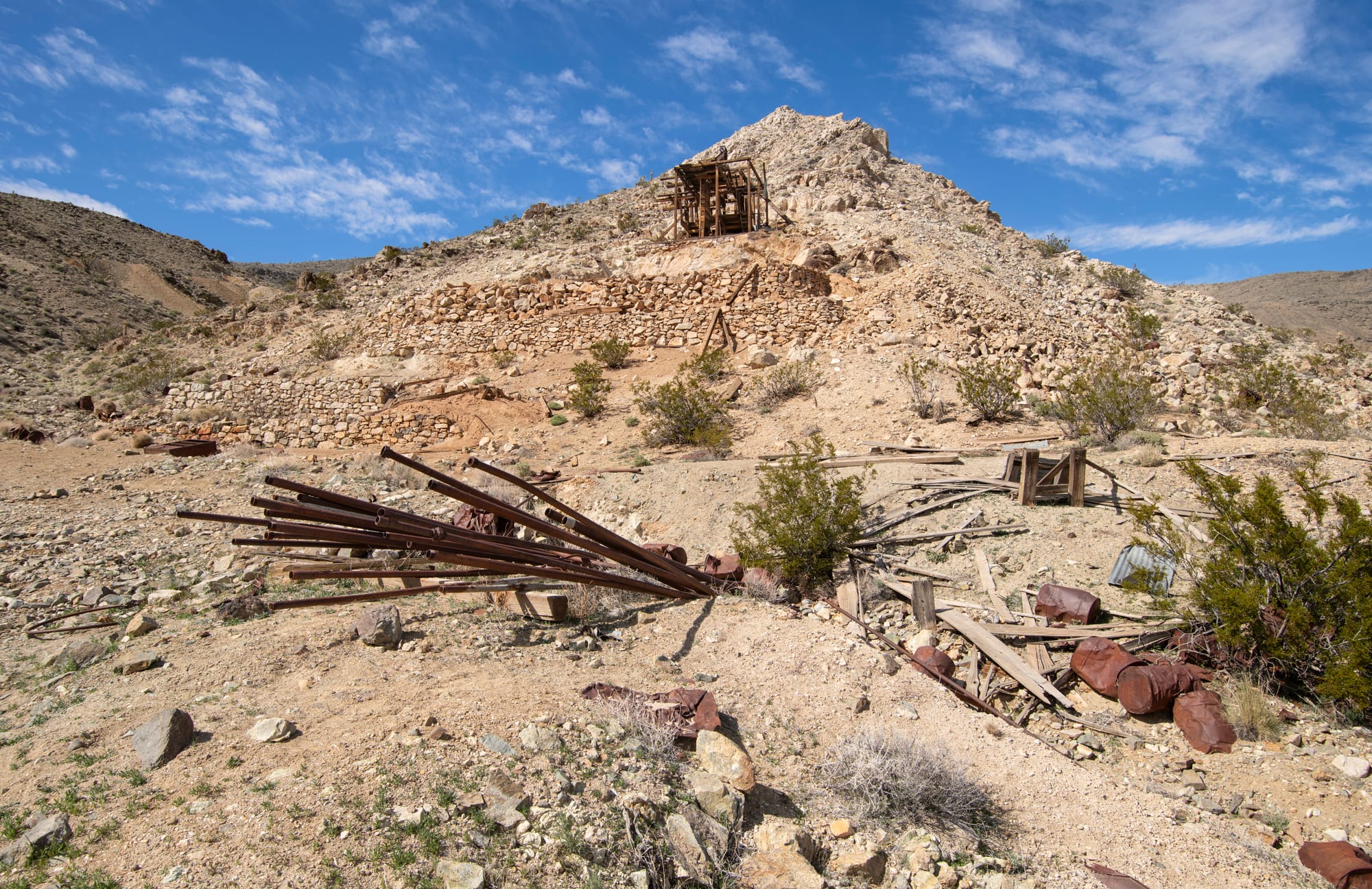
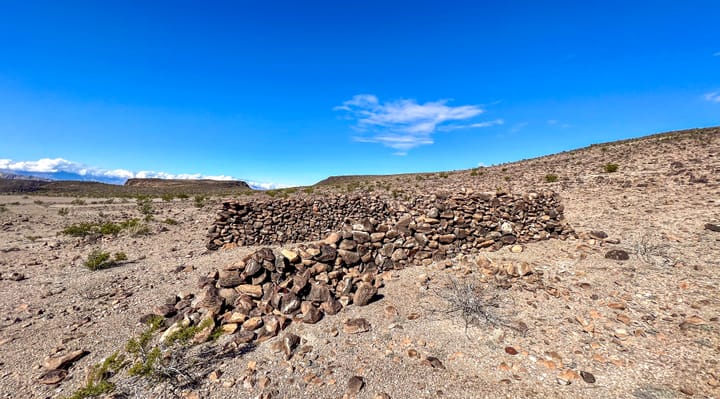
How long the mill actually ran is a bit of a mystery. One report says the plant was never completed. Another says it was finished in 1917 but proved inefficient. A 1949 account mentions a spring that "once supplied a forty ton gold mill operated many years ago by the Tonopah Mining Co." The 2,450 cubic yards of processed tailings still on site suggest it ran for some period, but at some point the working parts were salvaged. The timber frame and masonry foundations are what you see today. The property went idle around 1917 and stayed that way until the 1930s.
In 1928, Andy McCormick, who had been associated with the Lost Burro since its early days, took ownership. He and his partner Phil Day recovered $85,000 in gold. McCormick continued alone until 1938, shipping small lots of what he described as two-ounce ore.
Official Bureau of Mines records show only 255 ounces produced between 1935 and 1942, when a wartime executive order closed gold mines across the country. That was worth $5,281, not exactly a fortune even then. But the real number was far higher. Much of the early ore was shipped through Nevada and combined with Nevada mine output, obscuring the record. Geologist Jim McAllister studied the underground workings in the 1950s and estimated total production at 2,000 to 5,600 ounces, worth roughly $100,000. The California Division of Mines called these "reliable estimates" of ten to twenty times the recorded amount.
In the 1940s, a fruit stand operator from Desert Hot Springs named Bill Thompson acquired the claim. He and Alexander "Shorty" Borden, who never passed up an abandoned mine, relocated the original claims in 1948. Borden later quit-claimed his interest, and Thompson became sole owner in 1970. He worked alone at a mine that had once employed sixteen men, going to the Lost Burro whenever he could steal time from his fruit stand. He knew his predecessors had never gotten more than about $5,500 in officially recorded gold out of the property, but he dreamed he could do better. Thompson put up humorous signs around the cabin and mine camp, along with the usual trespass warnings; all have disappeared.
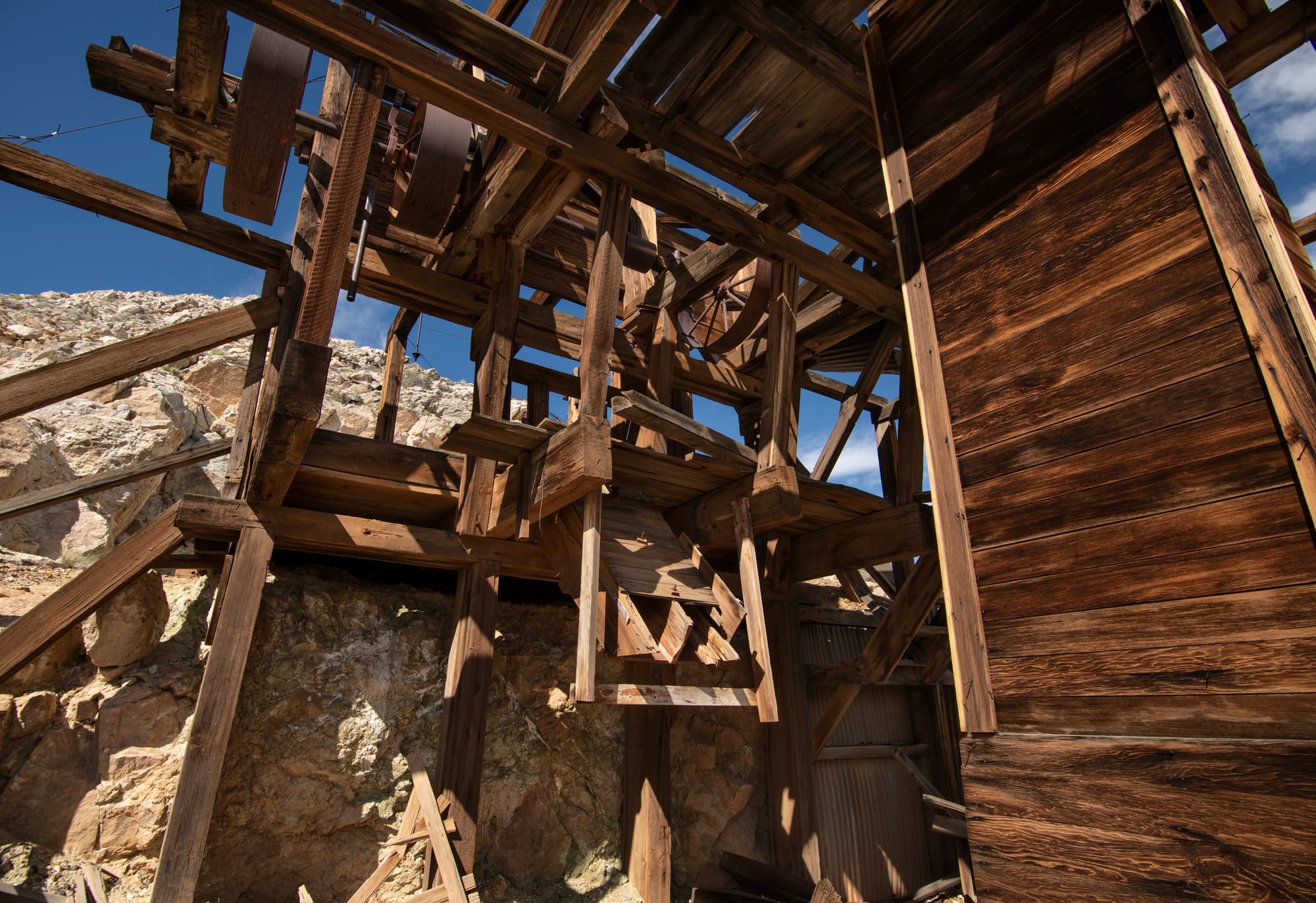
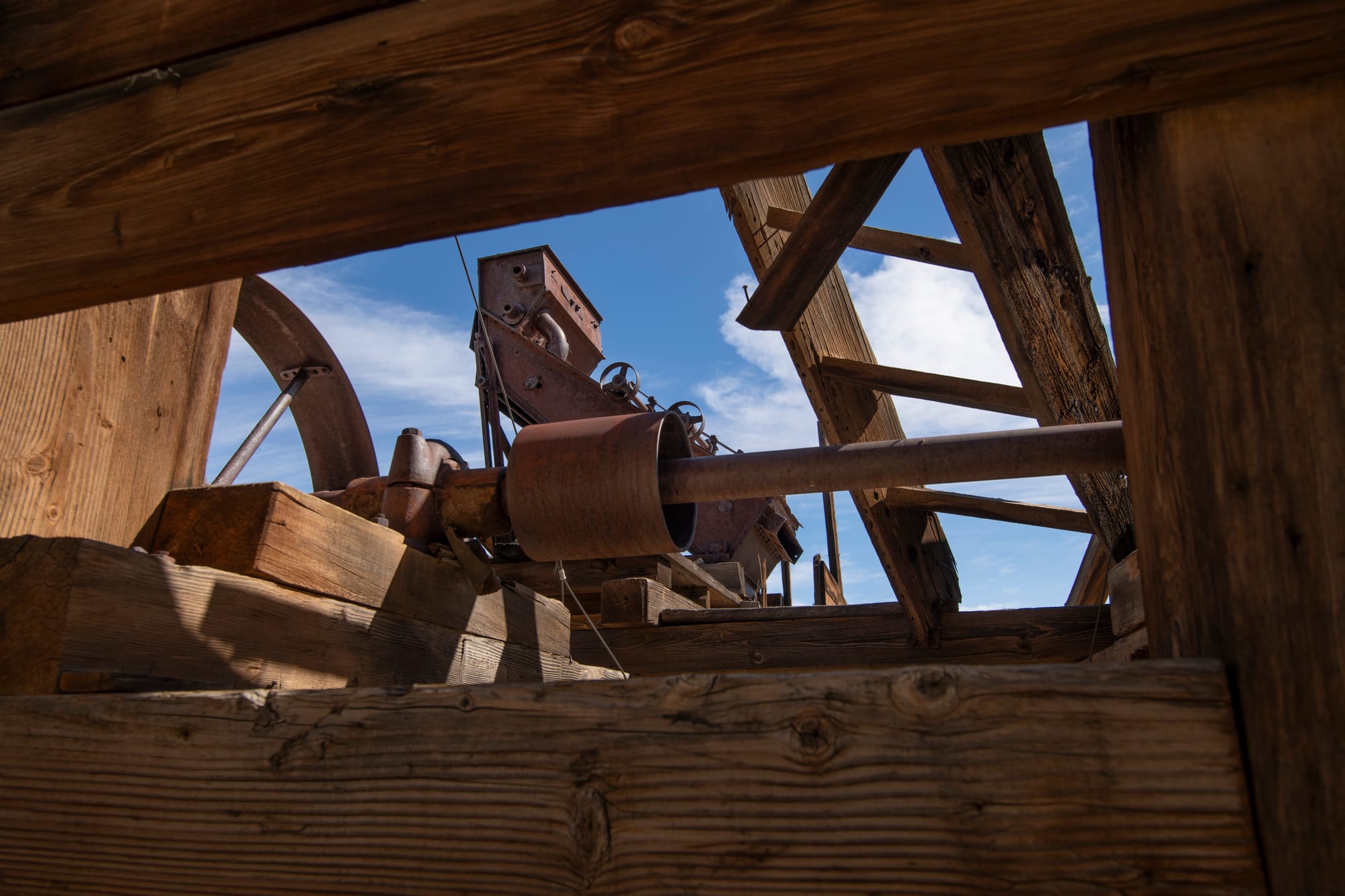
Inside the mill
Then the Mining in the Parks Act of 1976 required claims to demonstrate profitability. The Lost Burro was an unpatented claim and the government ground him down. His claim was due to be challenged in court, but Old Bill Thompson died of a heart attack in early 1980 before they could take it from him.
The gold that drew all of them to this barren canyon formed in a horizontal vein where intrusive rock forced its way up through the Tin Mountain limestone. Native gold collected in jasper cutting across shattered quartz in a vein one to eight feet wide. The reddish-brown mill tailings are hard to miss against the bluish-gray limestone. They were produced by mercury amalgamation and cyanide leaching. Don't camp on or near them.