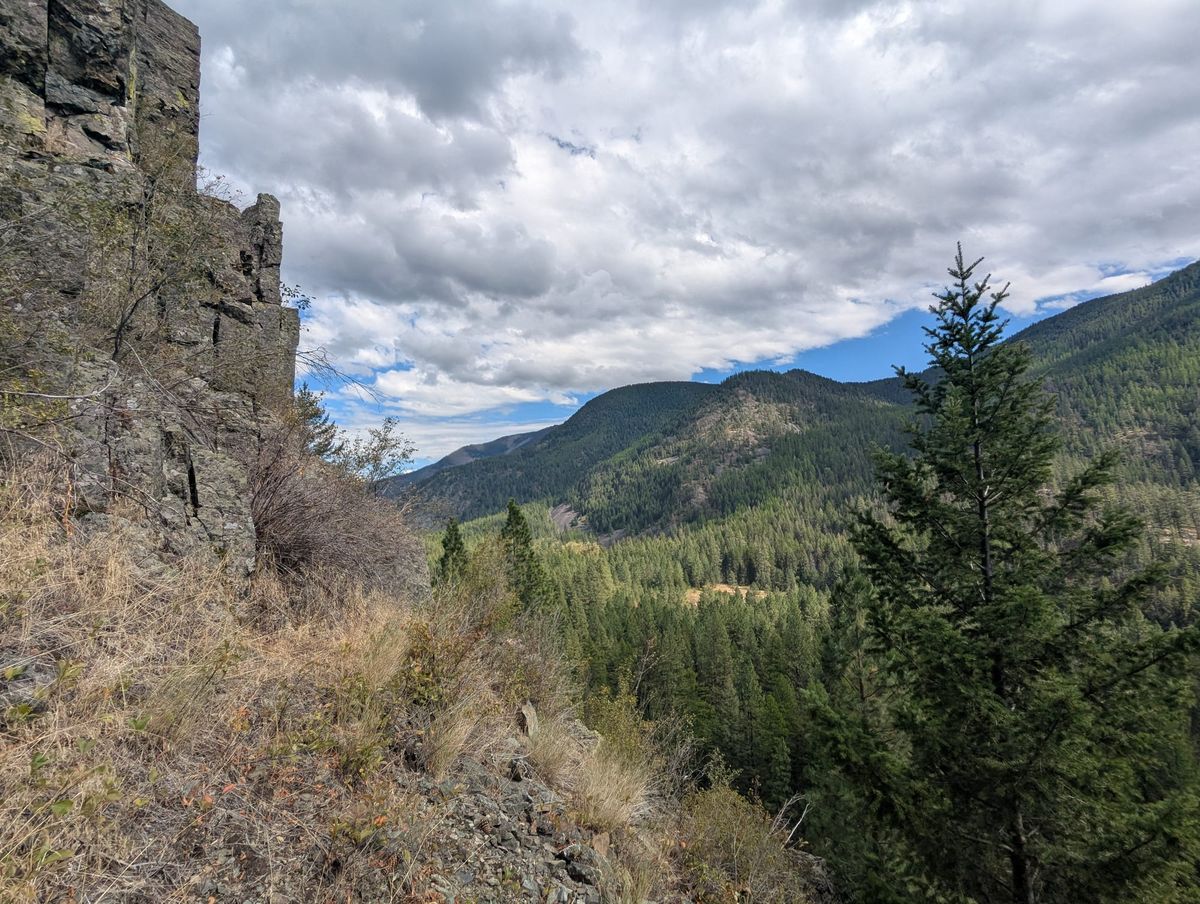
Swede Prospect is a site that has been nearly wiped away. Indeed, so little remains that I almost did not write about it until I read further into the prospect’s history. While only a few depressions, scattered rocks, and two filled and caved adits remain, the mine has a brief but colorful history, one that is all but invisible when visiting what little is left.
History
Several miles up Rattlesnake Creek, three Swedish miners worked a small gold prospect in a diabase dike for a short period in the 1880s or 1890s. The “Three Swedes” mine was first located in October 1885 by Herman Hutter and Gustavus Ohm as the Mammoth quartz lode, and ore from the claim was assayed at $5/ton (nearly $178 in 2026) the following year. A nearby resident named Sebastian Effinger also filed claims for the Homestake and Rattlesnake lodes in 1889, located in the same place as the Mammoth lode.

According to Forrest Poe, who was born on a homestead near the mine in 1908 and explored it as a youth, the adit dug by the three Swedes extended back 95 feet. The first twenty feet out from the entrance were timbered over so that the miners had a covered area for sorting the ore, but this burned and collapsed in a 1919 forest fire accidentally started by a nearby farmer burning his haystacks. At one point, the mine had a shaft at the end of the tunnel that was covered over by the time the Montana Power Company studied the area in 1975. A 1983 survey by the US Bureau of Mines additionally noted the presence of a second, caved adit further up the hill, “possibly 250 feet long,” that does not show up in any oral histories of the site.
Forrest Poe also heard stories about the miners themselves from his father and neighbors. As the three miners lacked the money for sufficient supplies to develop the mine, they often left to work for wages to purchase items such as blasting powder. When they had enough supplies, they lived in a small cabin less than 800 feet southeast of the portal. The men never struck it rich, finding only the smallest traces of gold ore. The aforementioned 1983 Bureau of Mines survey confirmed the unprofitable nature of the mine: samples taken from both the dump and adit “contained no significant mineral values.”
“Coyote Bill” & The End of The Mine
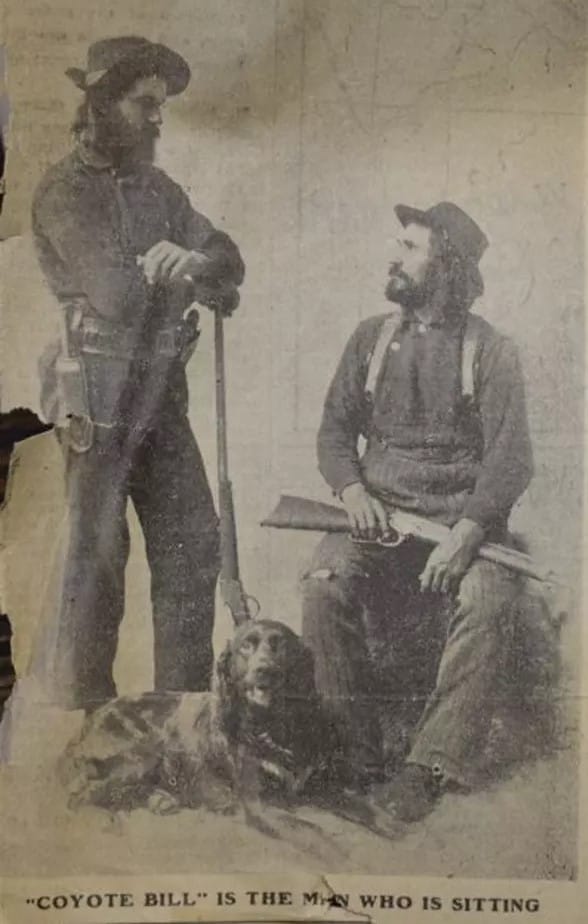
Noted in a November 1893 issue of The Anaconda Standard as a “Westerner of the type illustrated in the comic papers,” Karolus F. William Beeskove, or “Coyote Bill,” had been living up Rattlesnake Creek since before this date. Beeskove styled himself like General Custer and claimed that he owned all the mineral rights in the Rattlesnake. Thus, when he learned that the “three Swedes” were working a mine, he demanded a 50% cut of the (non-existent) profits; when they refused, he shot bricks off their cabin chimney. Due to either Beeskove’s intimidation or the lack of profits, the miners sold their property to Michael Whiteman, who then sold it to Fred Poe, Forrest Poe’s father, in 1900 or 1901.
After this, Swede Prospect was never worked again. In 1905, Beeskove tried to sell off his “Besemer Steel Mine” (two pits and less than six feet deep) for $25,000 or more than $950,000 in 2026. That same year, he shot and killed William Burrig, whom he accused of woodcutting on his land. Although “Coyote Bill” avoided hanging, he was later found dead, his wrists and throat slashed, near one of his gold prospects on Magpie Creek in 1916.
The Identities of the Three Swedes
Who exactly the “three Swedes” were remains somewhat unclear. In Daniel S. Comer’s 2005 thesis on historical habitation in the Rattlesnake Creek drainage, he asserts that two of the “three Swedes” were the prospectors Herman Hutter and Gustavus Ohm, but it is possible this was not the case and that three other prospectors instead developed the mine later. Despite Hutter and Ohm not being Swedish, they still could have been misidentified as “Swedes” by local residents. Other evidence, however, points to them not being the miners, as both crop up in local papers multiple times during the 1880s-1890s, and Hutter in particular ran a successful ice business. In other words, they don’t match the description of the cash-strapped miners given by Poe.
Another possibility for identities of the “three Swedes” comes from Sebastian Effinger’s 1889 claims. While Effinger can be ruled out as one of the miners because he was a prominent early homesteader who owned large tracts of land up the Rattlesnake, he located his claims with three others: Thomas Lefever, Gustave Oleson, and William Lehndorf. Gustave Oleson especially stands out, as he may be the same Gustave Oleson featured in an 1892 Anaconda Standard article about the Swedish miner’s near suffocation in a Butte, Montana, mine. Furthermore, other prospectors in the Rattlesnake area, such as those who developed Frenchman’s prospect to the northwest, were remembered by locals as periodically working in Butte for wages.
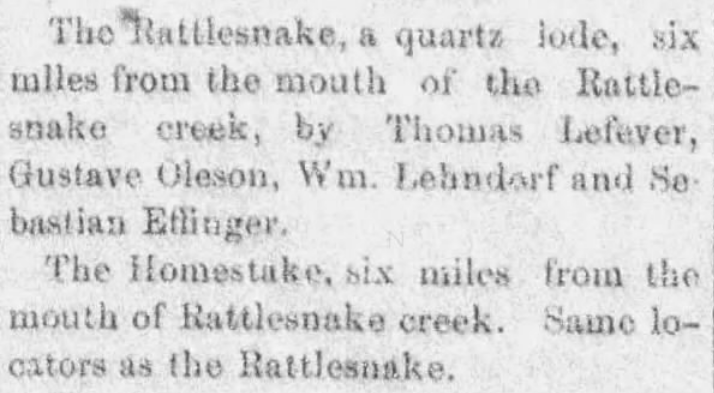
Aside from the 1889 claim and Oleson’s possible brush with death in 1892, the three prospectors who assisted Effinger do not appear again in any other local papers. Although Oleson was the only Swede among the three, the other two could have been misremembered in oral histories as Swedes as well. While there is little to go off of, it seems more likely that these were the “three Swedes,” rather than Ohm and Hutter. Still, the true identities of these miners may yet remain unknown.
Based on the above, the mine was most likely active in the late 1880s to early 1890s. Forrest Poe estimated in a 1988 interview that the mine was active before 1895, which tracks with this time period. On top of this, the earliest mention of William Beeskove is in the previously mentioned 1893 The Anaconda Standard issue, in an article that implies that “Coyote Bill” had already been living up Rattlesnake Creek for some time. In other words, the prospect was likely vacated before ~1893-1895, having been worked after ~1889.
Remains
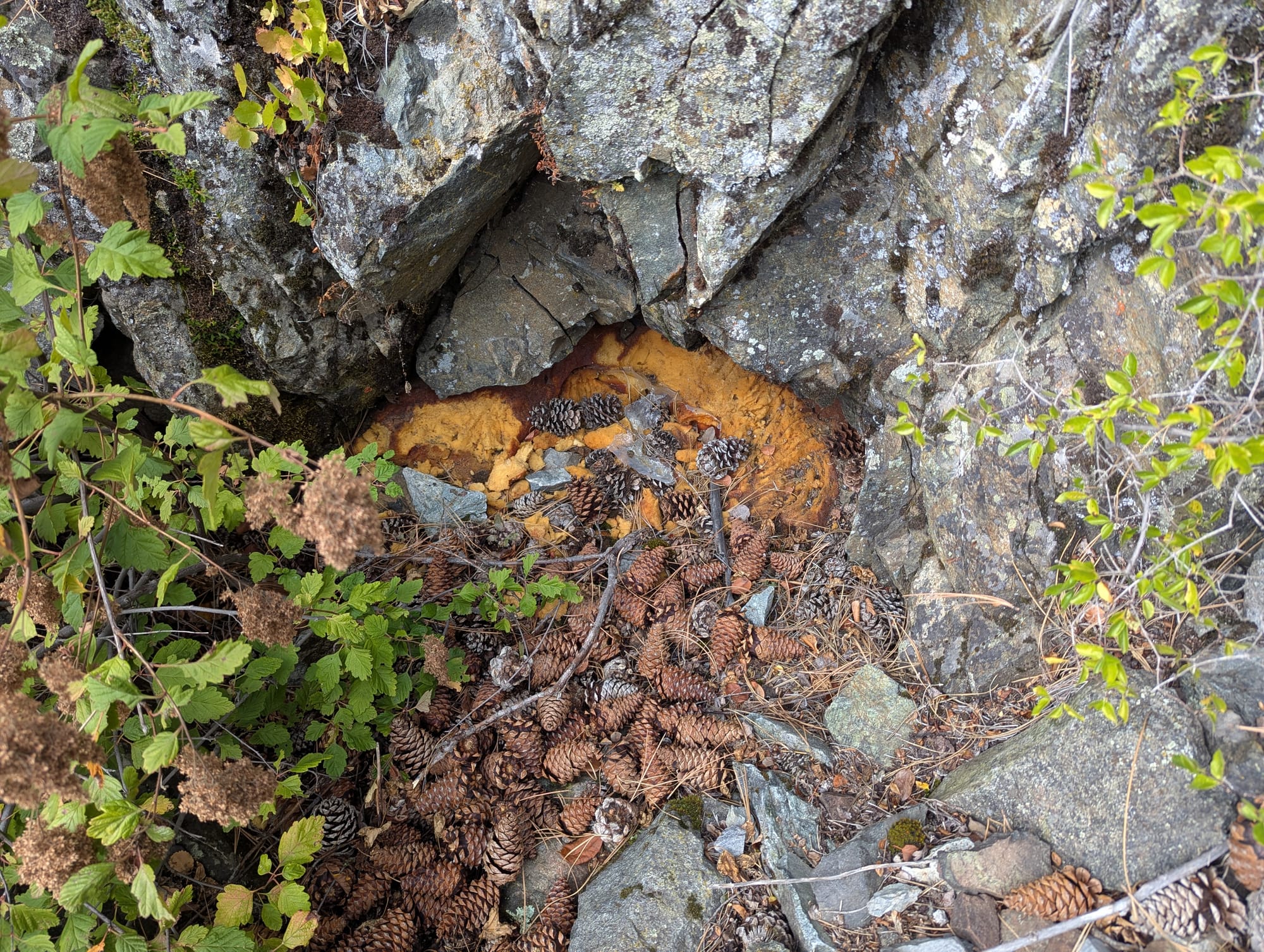
Until somewhat recently, the lower adit was still accessible, but it was blocked off with quick-expanding foam in the last several years. Today, the former entrance is almost obscured by thick brush and a pile of waste rock. Depending on the source, multiple different lengths are noted for the lower adit, the shortest being 40-50 feet, from the 1975 Montana Power Company study, and the longest being Forrest Poe’s estimate at 95 feet. Falling in near the middle, the Bureau of Mines surveyed the length of the adit at 69 feet with an 8-foot crosscut in 1983.
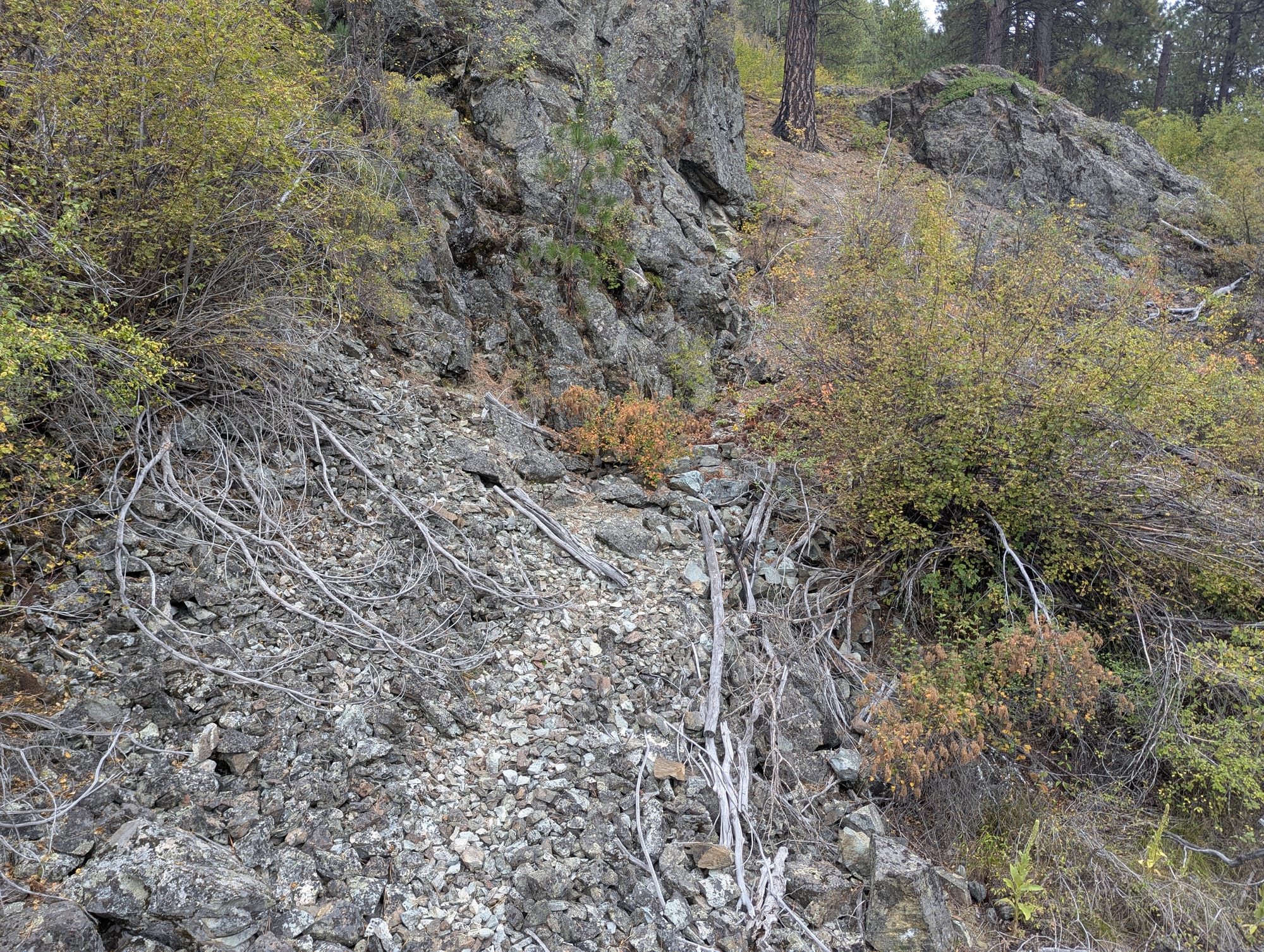
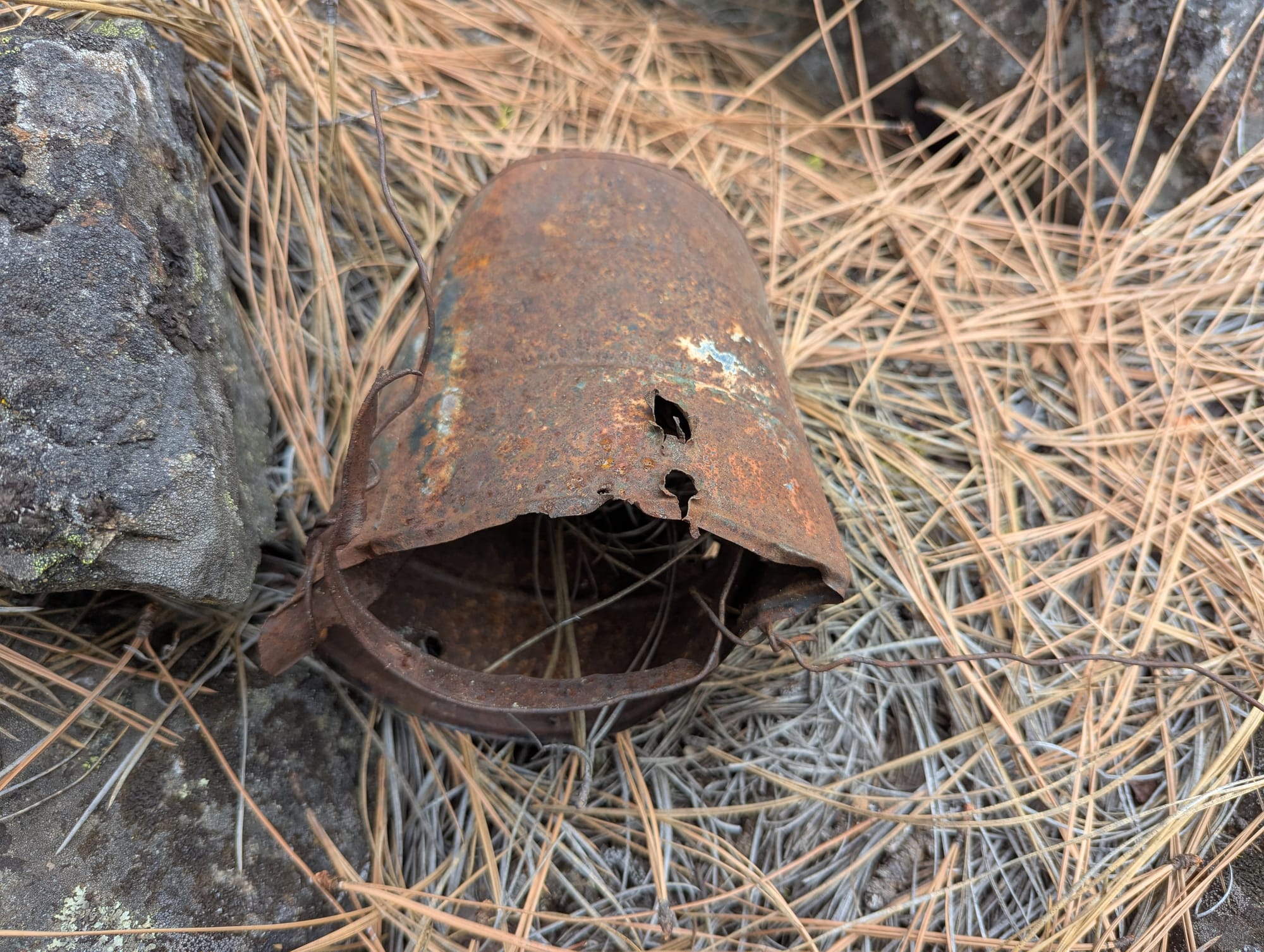
Even less remains of the miners’ cabin. It, along with other nearby structures, burned in the 1919 fire and was never rebuilt; nothing is left of it today except for a few scattered rocks that might once have been part of the foundation.
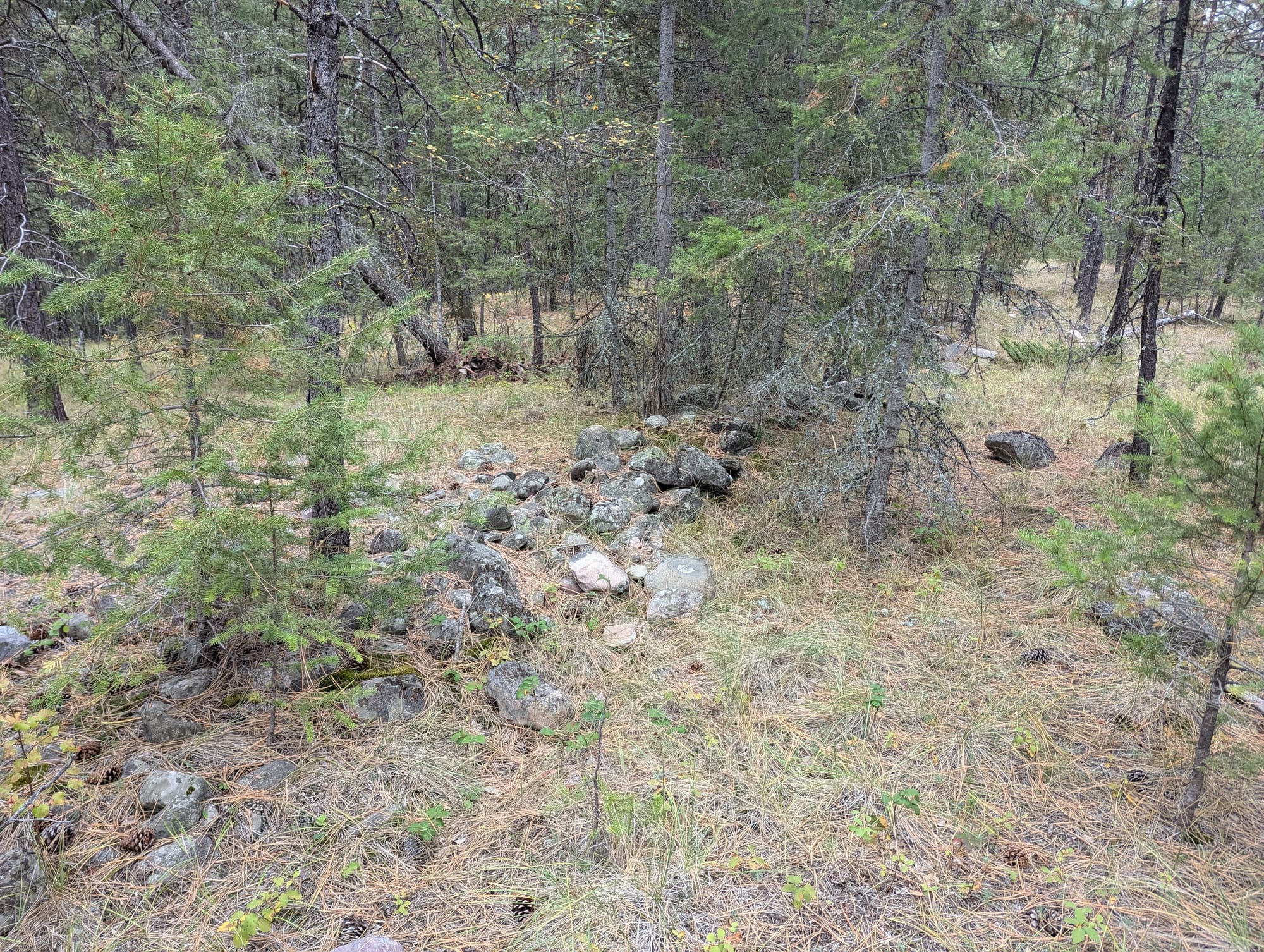
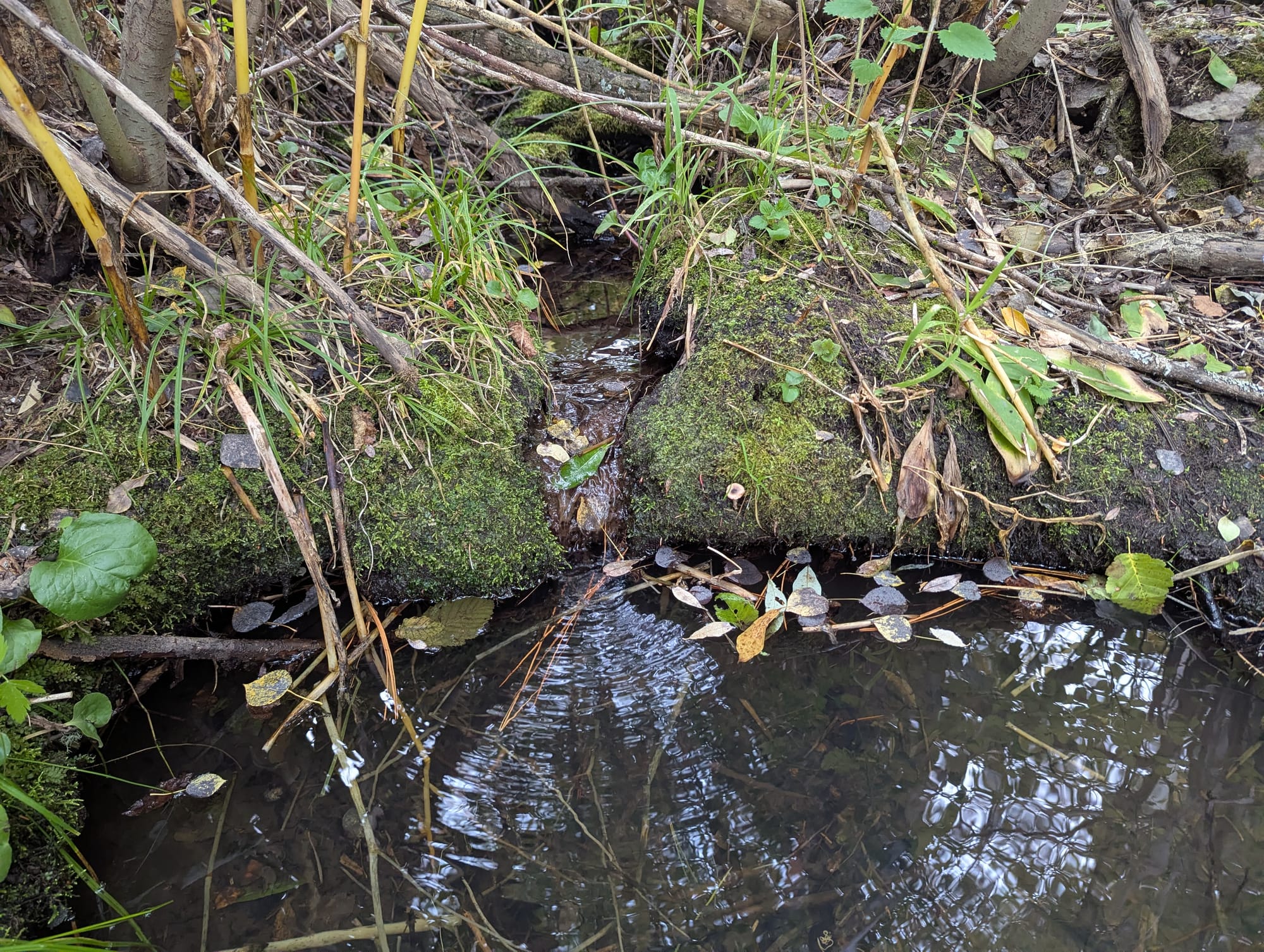
Perhaps the most prominent ruin is a rock wall that runs a few hundred feet north-south just east of where the miners’ cabin was. At the north end of the wall, an indistinct game trail climbs up to a spring above the mine that was developed by Forrest Poe’s uncle, Mark. When the air is still, all that can be heard is the gurgle of the spring. In this near silence, it is easy to imagine the three miners walking past after a long shift of finding nothing.
Special thanks to the Poe family and the University of Montana.
No directions / GPS coordinates to this site.