The Deadwood Mine sat so far from civilization that during winter, the only way in was a two-day trip by dog sled. From early November through late June, snow buried the roads across three mountain passes. Dog teams under contract made the fifty-two-mile journey from Cascade three times a week, hauling a hundred pounds of mail at two cents per pound. During the brief summer months, trucks took over, running around the clock to haul out concentrates and stockpile enough supplies to last through another long winter.
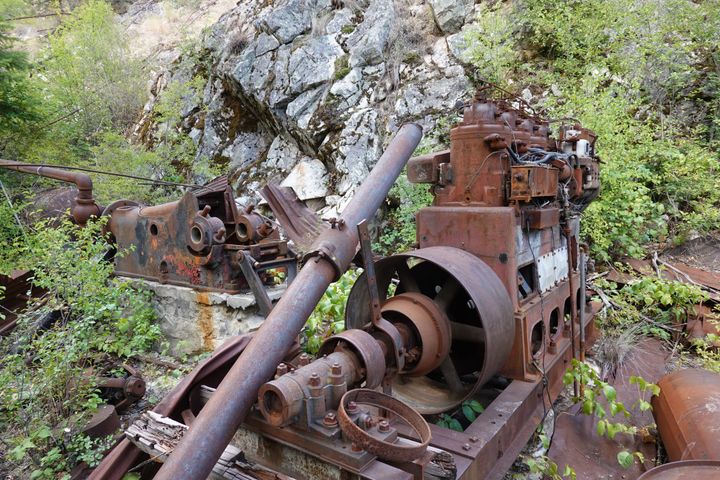
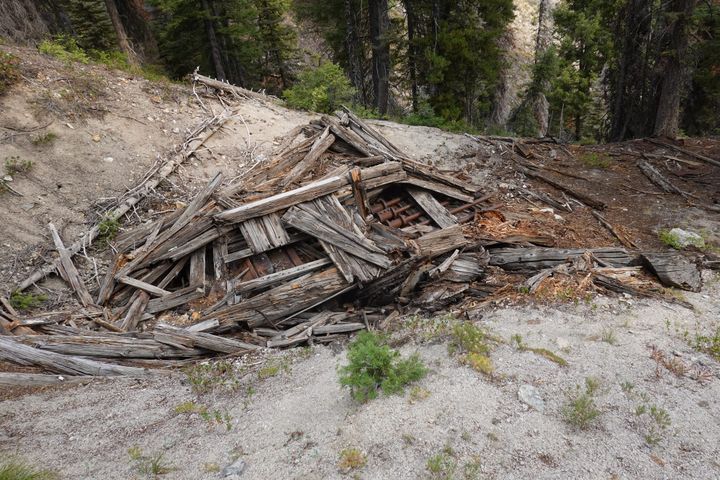
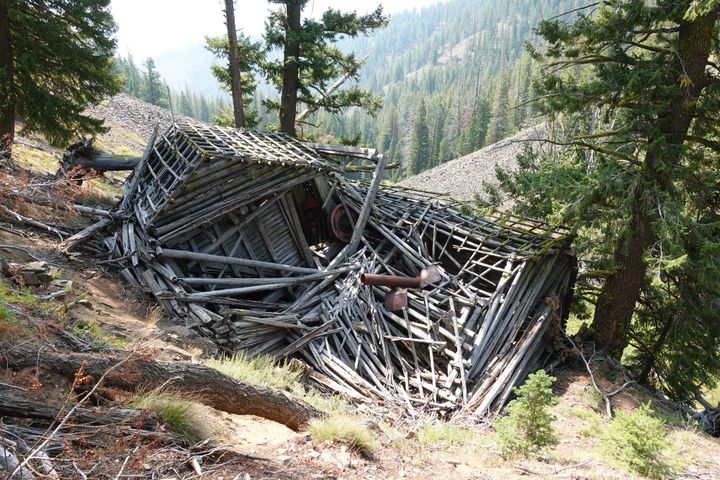
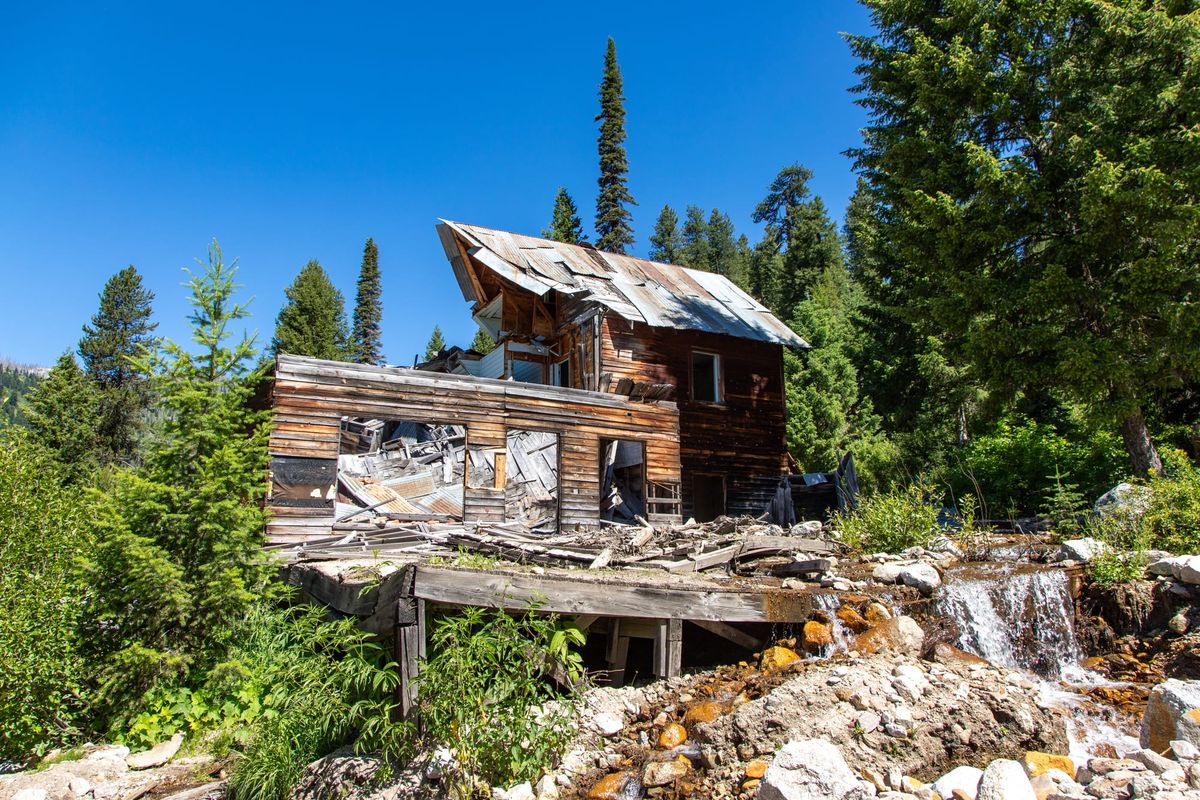
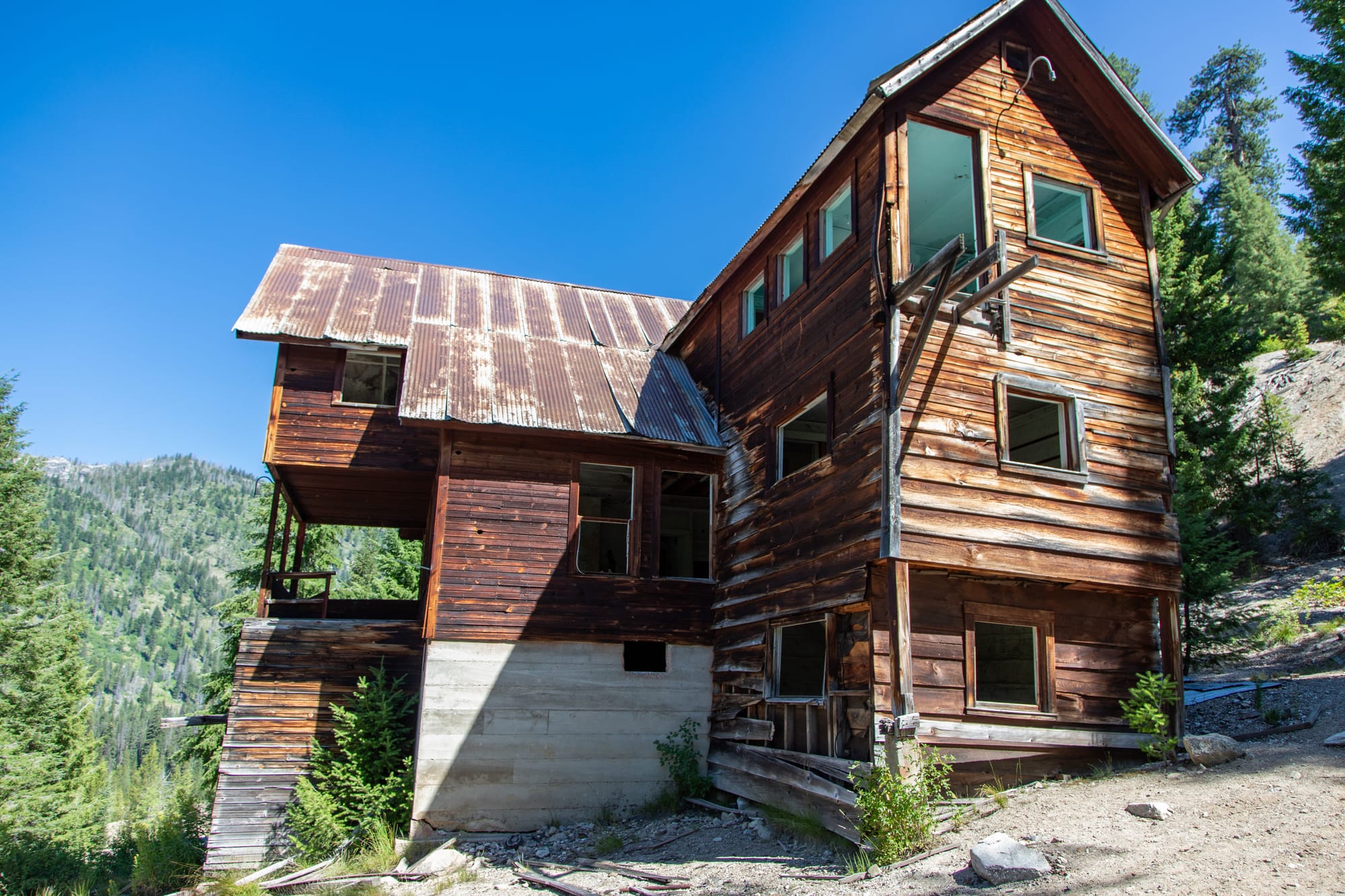
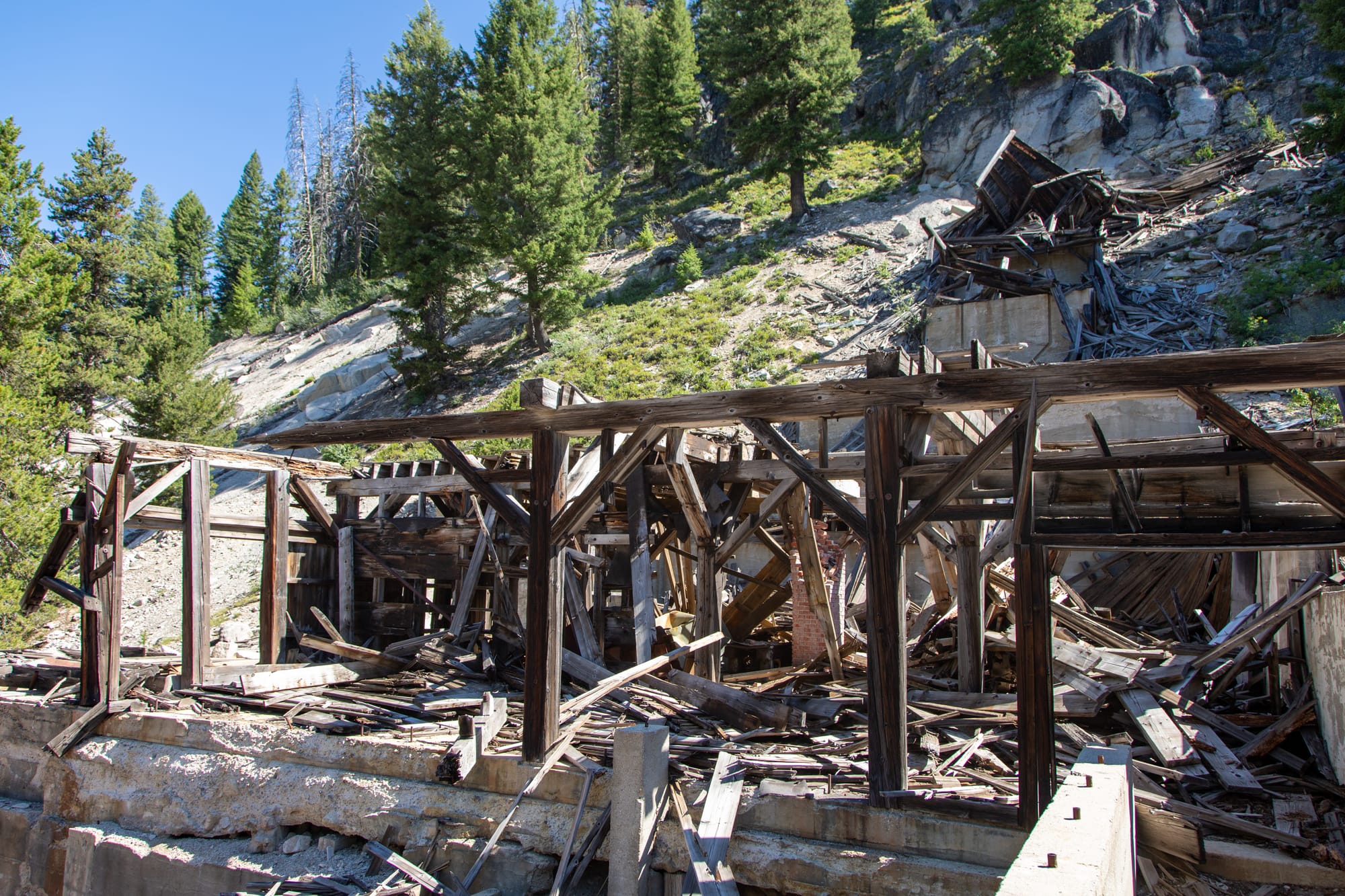
We stopped here in 2020 on our way to other mine camps in the area. Located in Valley County about fifty miles east of Cascade, the skeleton of the mill still stands, along with the two-story office and bunkhouse, which has a large safe built into its concrete wall. A creek runs through the camp, past old rails and scattered debris.
History
Placer gold drew the first miners to Deadwood Basin in the summer of 1863. A brief revival from 1867 to 1868 brought as many as a hundred men to work the creek beds, with one three-man crew washing out $5,000 in two weeks using a hydraulic cannon. By 1876, Deadwood City was a ghost town.
The real wealth lay hidden. For years, prospectors puzzled over pieces of rich galena float washing down from somewhere above. In 1905, the Hall Brothers finally solved the mystery by sluicing off deep surface debris with water from a long ditch. They exposed a lode one hundred feet wide, with twenty to thirty feet carrying lead values of ten to twenty percent, and masses of clean galena running sixty to seventy percent lead.
James H. Hawley, whose career ranged from prospector to lawyer to governor of Idaho, had discovered a narrow outcrop of high-grade silver-bearing quartz on nearby ground back in the 1880s. A small shipment sent by pack mule to the Ketchum smelter proved unprofitable. Now three companies formed to work the combined deposits: the Hall Interstate Mining Company, the Lost Pilgrim Mining Company, and the Deadwood Mining Company, Limited.
Small-scale work continued for years until October 1923, when Oscar Hershey, consulting engineer for the Bunker Hill & Sullivan Mining & Concentrating Company, visited the property. He was impressed. "The Hall-Interstate impresses me as being the prospect for which we have been looking for a long time," he wrote to management. After receiving assay results, he grew even more enthusiastic: "It now appears to me that copper is an important constituent of the entire ore-shoot... It seems to me that I must have figured wrong somewhere for I can hardly think that a thing like that is lying loose in the State of Idaho."
Bunker Hill acquired the property in May 1924 and immediately began building a camp: a large two-story boarding house, powerhouse, shop, barn, and outbuildings. Everything had to be hauled in from Hailey through Stanley Basin and Bear Valley before the roads closed. For three years, engineers drove tunnels searching for the main ore vein. They finally found it in 1927 and proceeded to construct a 100-ton-per-day flotation mill, a 250-horsepower hydroelectric power plant, a sawmill, office, and employee housing.
The investment paid off quickly. Operating for only four months in 1929, the mill processed nearly 3,000 tons of ore. The following year expanded to nearly 25,000 tons. Concentrates were trucked fifty-four miles to loading bins at Cascade. Average mill feed in 1930 ran 311 ounces of silver per ton, 3.5% lead, 10% zinc, and 0.5% copper.
Then came the Great Depression. Bunker Hill closed the mine at the end of May 1931, leaving a small crew to maintain the property. By June 1932, all supplies had been removed and the company forfeited its claim options.
The property sat idle until July 1940, when Leverett Davis obtained a lease and put a crew of ten men to work. The main tunnel had caved after the 1931 closure, and by year's end they had reopened about 1,000 feet of adit. Callahan Zinc-Lead then obtained a long-term lease and rehabilitated the mill.
Wartime demand for strategic metals brought government incentives, but the isolation remained a challenge. When Callahan requested government assistance in 1942, Bureau of Mines geologist Shenon was skeptical: "The Deadwood property, I believe, is 60 miles from the railroad at Cascade and over three high summits. The truck and tire wear per pound of zinc would be high."
Despite these doubts, Callahan persisted through the war years. By 1944, the camp had expanded to include a cookhouse, general store, schoolhouse, and twenty-five houses. But the mine never yielded the grades and quantities hoped for. Facing limited reserves and labor shortages, Callahan curtailed operations in 1946 and surrendered the lease the following year.
From 1929 to 1950, the Deadwood Mine produced approximately 126,000 tons of ore, yielding roughly 2,700 ounces of gold, 634,000 ounces of silver, 444,000 pounds of copper, 5 million pounds of lead, and 10 million pounds of zinc.
Howard Frisk includes a chapter on the Deadwood Mine in his book Abandoned Mines of Western Idaho, featuring several of my photographs.
Some links are Amazon affiliate links. Purchases through these links support this site at no extra cost to you.