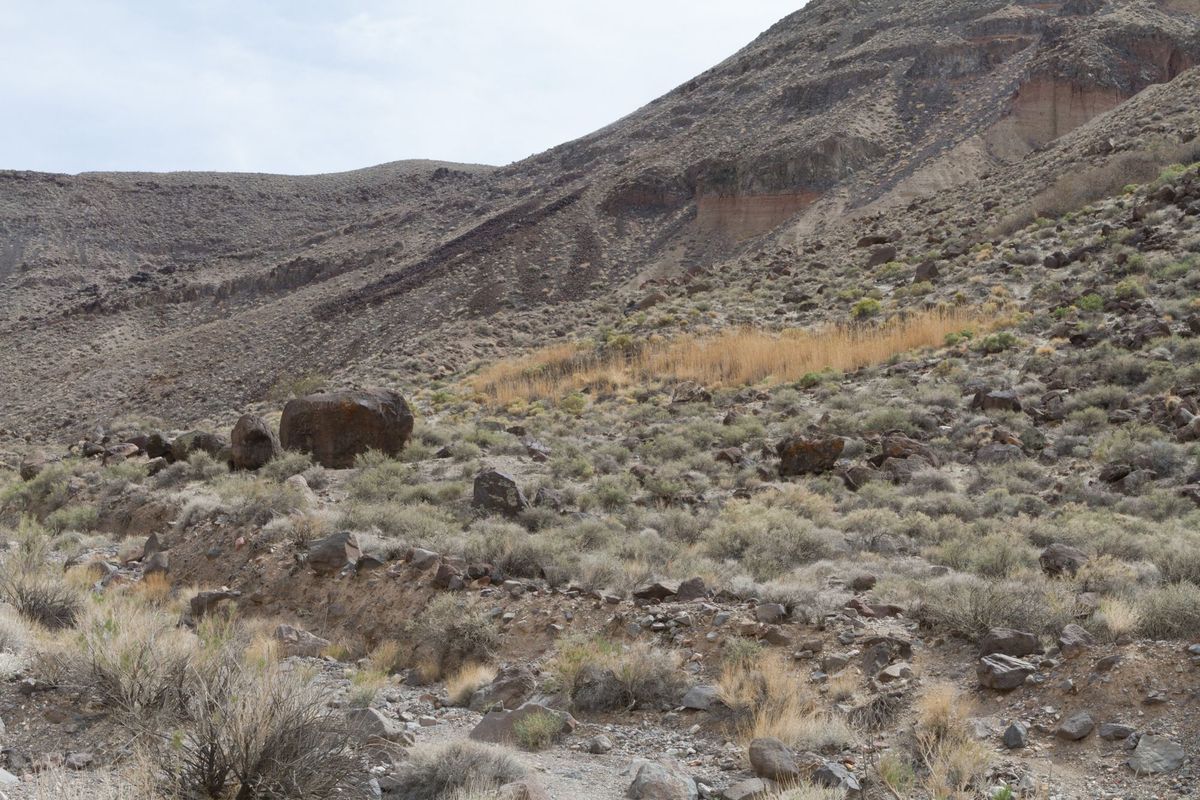
In 1936, two young men from a Civilian Conservation Corps camp, Rockey Cochran and Farland Wells, followed a local Indian named Tom Wilson up a nameless side canyon in the Panamint Mountains. Wilson led them to a cluster of dark lava boulders near a seep on the canyon's western slope. Scratched into the rock alongside ancient petroglyphs were the letters "W.B.R." and the year "1849." It looked like proof that the Jayhawkers, a group of 49ers who had passed through this canyon on their escape from Death Valley, had left their mark almost ninety years earlier. The spring was given its name on the spot. But there's a problem with the story, and it starts with a simple question: would a starving man stop to carve his initials?
The Jayhawkers were about three dozen men, mostly from Knoxville and Galesburg, Illinois, among roughly 100 emigrants who converged in Death Valley in mid-December 1849. Trapped in the valley with dwindling supplies, they burned their wagons near what is now McLean Spring, slaughtered their oxen, and smoked the meat for the climb ahead. One of them, William B. Roode, left inscriptions at several places around the Panamints, including here at the spring and at Roode Rock on the alluvial fan near Lemoigne Canyon. The "W.B.R. 1849" inscription became the centerpiece of a long debate over whether the Jayhawkers followed this canyon during their escape.
History
Carl Wheat, a Western historian, visited the inscribed boulders shortly after the 1936 discovery. He published his findings in the 1939 Sierra Club Bulletin, concluding the W.B.R. inscription was "the long-sought proof" of the Jayhawker route through the canyon. The spring was mapped under its new name, and the case seemed settled.
But the evidence is more complicated than Wheat allowed. LeRoy Johnson, writing in 1999, pointed out that the clean, deliberate quality of the carved letters looks like the work of someone with proper tools, not the improvised scratching of a man who had just abandoned everything he owned to survive. Johnson noted that Rood returned to this area twenty years later on a prospecting trip, equipped with pack animals, a pick, a single jack, and chisels. A man outfitted like that could carve clean letters. A starving emigrant could not.
Michel Digonnet, in his hiking guide to Death Valley, offered what I think is the most plausible take. Rood may have returned in 1869, seen the inscriptions left by an 1860 expedition, and felt entitled to backdate his own mark to record his historic 1849 passage. Most of the evidence suggests the Jayhawker parties crossed the Panamints at Towne Pass, several miles to the north. It's possible Rood's small group split off and found the spring, while the larger parties never came this way at all.
The main boulder is covered with inscriptions, roughly five feet on a side. Besides the "W.B.R. 1849" mark, it bears the names of Dr. E. Darwin French's 1860 prospecting expedition: "J. Hitchens 1860," "Frank L. Weston March 27 1860," and "T. G. Beasley." Other partial inscriptions hint at additional Jayhawkers: "lar" might be Andrew Larken, and "rier" (with the first letter missing) might be Reverend Brier, but who knows. The spring itself is up the slope behind the boulders, and despite the name, there is no surface water. It's a reedy patch of cattail.
French was here looking for silver. On the climb out of the valley, one of the Jayhawkers had picked up a piece of float so pure he fashioned it into a replacement gunsight, and the legend of the Lost Gunsight Lode was born. French organized his 1860 expedition specifically to relocate the vein. His party stopped at this spring, reportedly just below the snow patch where the ore had been found, and headed down into Death Valley instead of climbing the slopes above. The Lost Gunsight remains lost.
In 1861, the California-Nevada Boundary Commission sent a reconnaissance group of 15 men with about 24 mules and three camels, led by Dr. J. R. N. Owen. Hitchens and J. H. Lillard, who had prospected the area with French the year before, knew where the water was and guided the party into the canyon. The camels could not negotiate the steep side-slope into the canyon with packs on, so the mules, already worn out, had to carry the camels' loads down in addition to their own.
On that 1869 return trip, Rood led a prospecting party that included George Miller, Paul Van Curen, and Eugene Lander. They found the old Jayhawker campsite near the head of the canyon with charcoal from campfires and cattle bones still visible. The Jayhawkers had reportedly buried between $2,000 and $2,500 in gold coins at a "Summit Camp," but a cloudburst had washed away part of the canyon where the gold was buried. The coins have never been found.
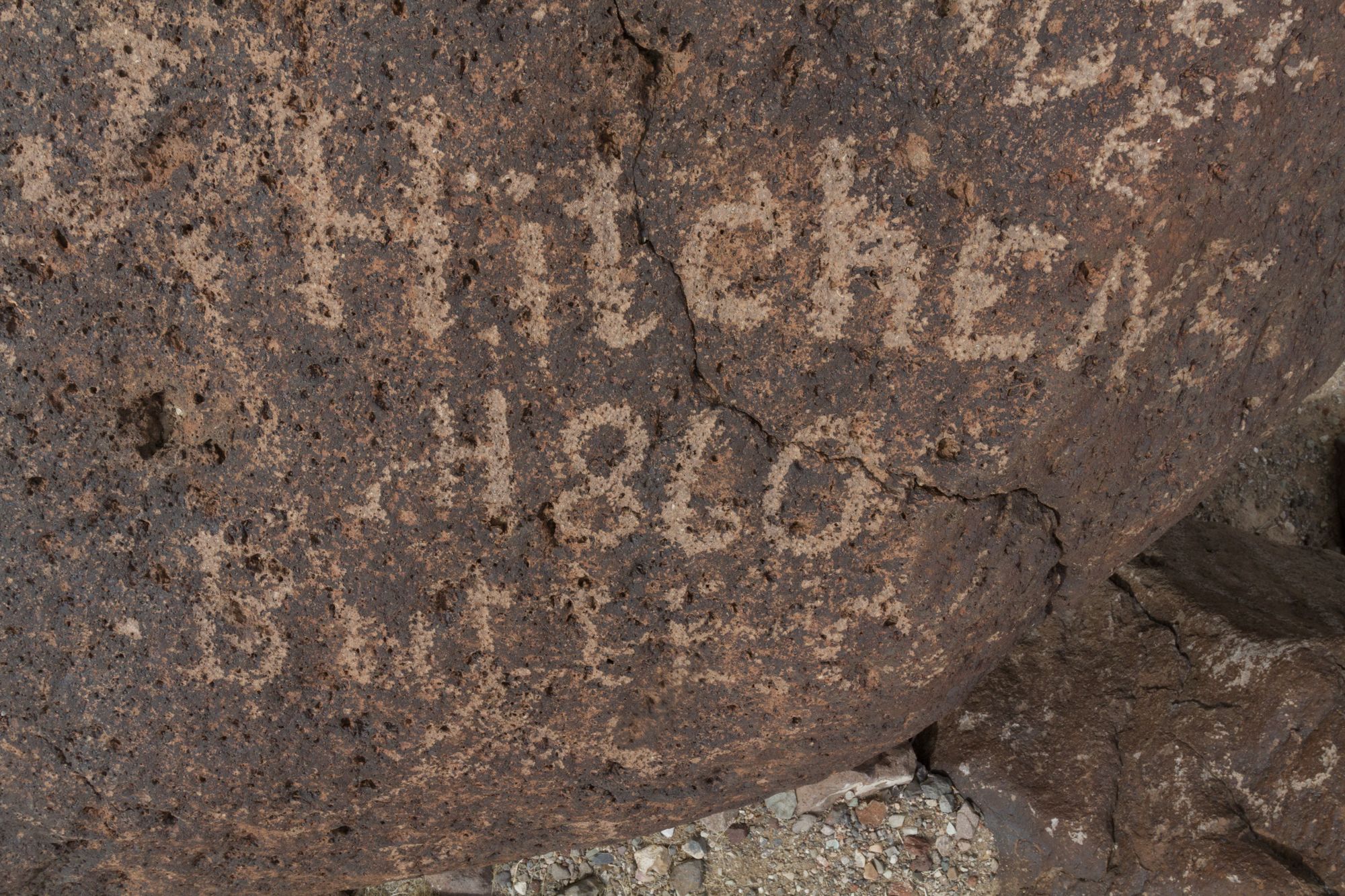
The historic inscriptions share these boulders with much older work. The rock art ranges widely in age and style: bighorn sheep in several variations, small human figures, and abstract patterns that nobody has convincingly interpreted. One recurring element, a column of linked circles, shows up at Titus Canyon and Marble Canyon as well, suggesting it carried specific meaning across a wide area. The oldest figures likely belong to the Desert Archaic tradition and predate the Timbisha Shoshone presence in the valley by thousands of years.
The Shoshone certainly knew this canyon and its water. When "Panamint George" Hanson, a Shoshone elder who was nearly 100 years old in 1939, recalled the 49ers passing through, he described the white men as having "long whiskers and big cows." His people fled the emigrants but followed them afterward for anything discarded. The Shoshone knew where the water was, and they knew the trails. Tom Wilson, the man who led Cochran and Wells up this canyon in 1936, knew exactly where to go.