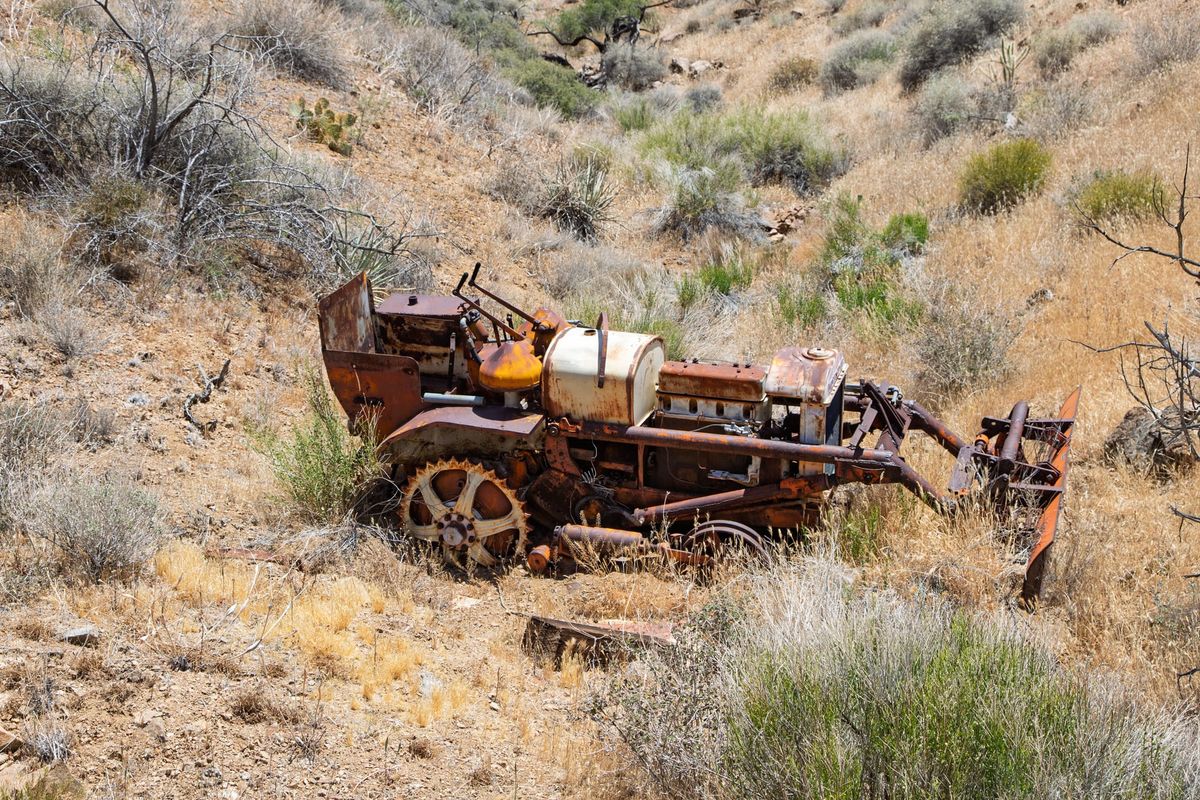
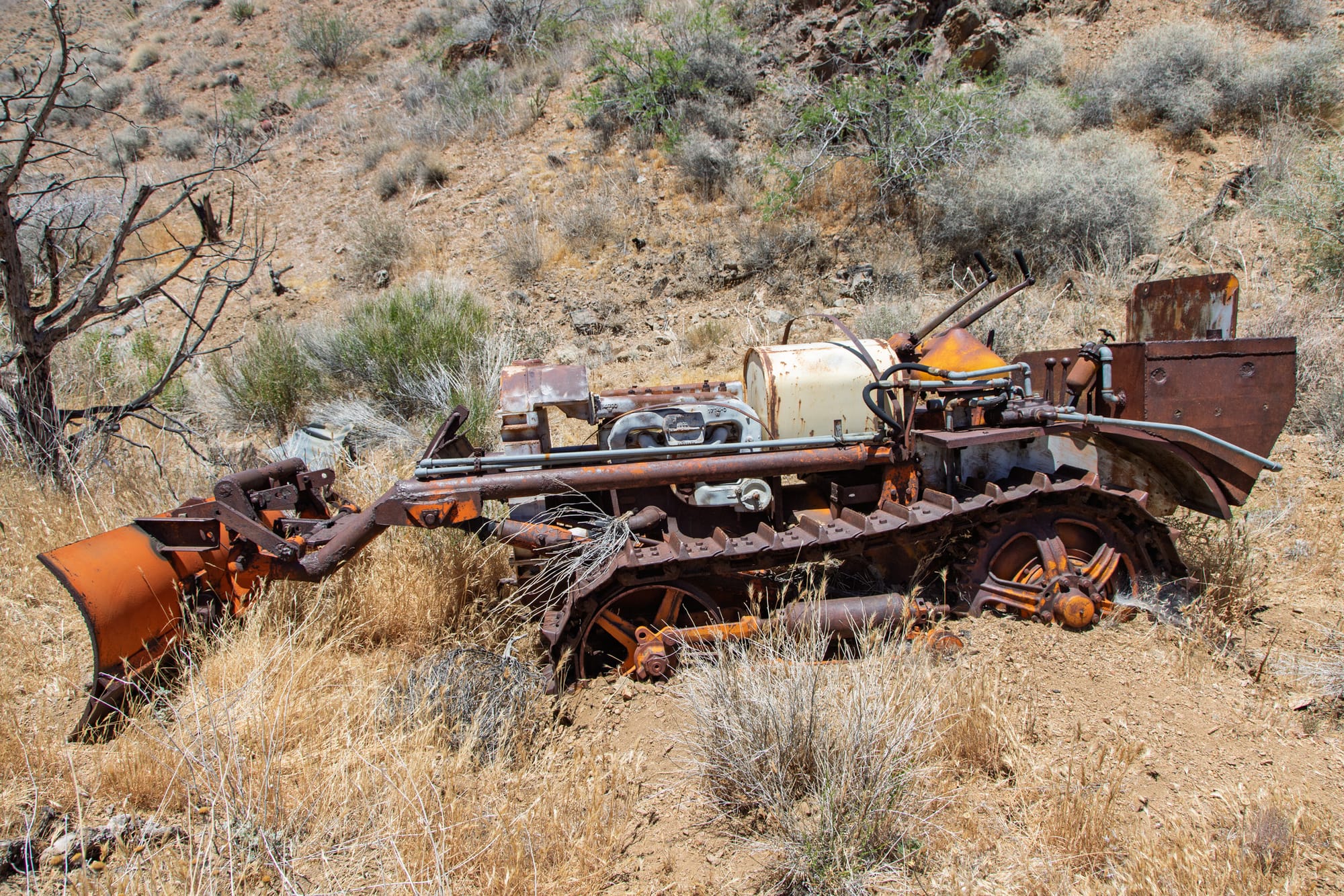
There is a crawler tractor sitting on a hillside in the Mojave National Preserve, well off any road. It is a McCormick-Deering 10-20 TracTracTor, International Harvester's first production crawler, and it is one of the earliest ever built for sale. Machines this old or unusual rarely survive anywhere out in the wild.
My friend Francis Blake wrote the machine up in Farm Collector in 2012. He found the serial number stamped on the engine block and scraped the rust off it with his pocketknife: TT 573. Production started on 1 October 1928 at serial TT501, and 1929 opened at TT701, which makes this the seventy-third machine of the run.
International Harvester had built experimental tracklayers a decade earlier, and outside firms had been bolting track units onto McCormick-Deering wheeled tractors since about 1924, but this was the first crawler the company sold itself.
It also wears a bulldozer blade at least twenty-five years younger than it is. Somebody hauled a tractor that was already a quarter of a century old up a canyon to a mine that had quit producing before the Second World War. Then they bolted and welded on a blade plumbed with galvanized water pipe and apparently put it to work.
I am not saying where it is. Blake withheld the location and asked me to keep that agreement. It is inside the Mojave Preserve and it is protected. It is fine exactly where it is.
History
The 10-20 was a small machine by any standard, with a four-cylinder engine of 284 cubic inches making 27 horsepower at the belt. It would run on gasoline or kerosene, and you can still read the choice on the manifold: a cast plate with GASOLINE at the top and KEROSENE at the bottom, and a lever between them. The steering levers pivot upward from the clutch housings so the machine can be driven standing up.
The blade is a puzzle. It is hydraulic, not cable-operated. The control valve is cast GRESEN over MINNEAPOLIS in a plain oval. The earliest trace of Gresen hydraulics anywhere in the published record is 1953, and the company did not file its first hydraulic valve patent until 1961. Whether it built anything before the 1950s is not documented. Hydraulic dozer blades for International crawlers do not show up in the mining trade press until 1947 either.
So the blade is post-war and the tractor is pre-war, by a wide margin, and the hydraulics have the look of something built rather than bought. Ordinary water pipe and elbows run alongside rubber hose. The welds holding the push arms together are thick and lumpy, laid down by hand. A small tag riveted to the back of the moldboard is stamped BD1816, which is the only mark the blade carries. I have not been able to find out who made it. If you know more, please let me know.
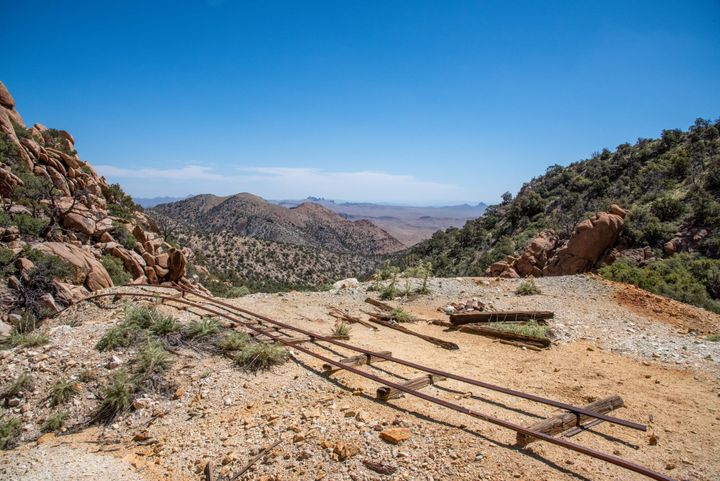
Most think this was a gold mine, but it primarily produced silver. Molten rock pushed up into older Precambrian granite gneiss, and the gold veins stayed down in the intrusion while the silver stayed in the roof above it. These workings are in the roof, which is why the ore ran tens of ounces of silver to the ton against under an ounce of gold. The mine produced in four scattered years in the 1920s and 1930s, shut down before the war, and never shipped ore again, though the Bureau of Mines allowed that the real output was probably several times what got recorded. Men working a small claim like this one were not exactly good about keeping careful books.
What the mine did not have, in any account anyone ever wrote of it, is a tractor. The Bureau of Mines surveyed the site in the 1980s and wrote down a trailer, a storehouse, a windmill, an ore bin, a mill foundation, a leach vat, a tailings pond, the roads, and a headframe over the main shaft. No machinery at all.
That leaves an obvious question. Who brought it out here, and when? Somebody was working here long after the ore stopped moving. Claims were relocated over the old workings in the 1960s and somebody ran leaching experiments on the dumps and the tailings. A worn-out tractor with a homemade blade is exactly the kind of equipment a small outfit like that would scrape together.
Blake floated another possibility, that the crawler started life as a farm tractor and reached the mine secondhand. I think that fits. A long drought in the 1920s drove the homesteaders out. Only three families remained by 1926, and the local post offices closed in 1926 and 1927. A few holdouts hung on into the 1940s, but widespread farming was done. A tractor like this one could have stood abandoned in a field for years before a prospector decided it still had work left in it.
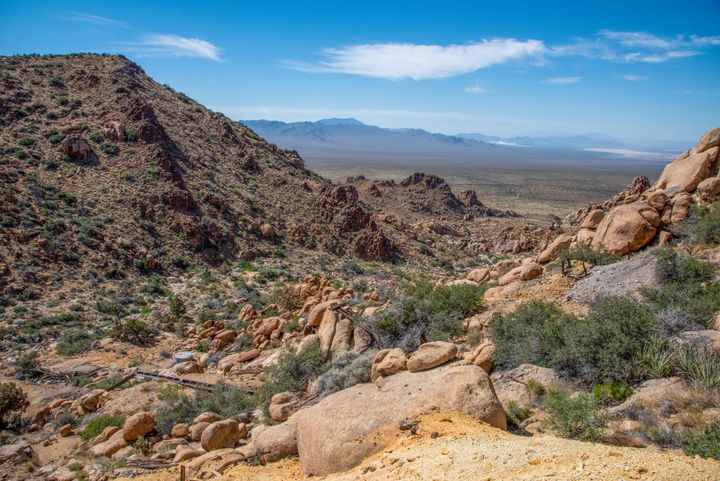
The country around the machine burned in June 2005, in one of the fires that combined into the Hackberry Complex and took a little over seventy thousand acres. This was pinyon and juniper woodland before that. It is grass, low brush, and standing deadwood now. When I hiked up there in May the machine sat in dry grass with blackened stumps around it, the right track gone entirely and the left track still on. The blade is still painted bright orange, the fuel tank cream, the castings yellow.
The strangest thing about it is where it sits. The machine is in a gully on a hillside, away from the workings, away from any road, with nothing above it that anyone ever dug. It did not roll down from anywhere, because there is nothing up there to roll from. I cannot think of a job that would have put a bulldozer in that gully.
I also wonder where the right track went. There is no sign of it anywhere nearby, not a shoe, not a pin. A crawler cannot move under its own power on one track, so either it threw the track after it was parked here for good, or somebody hauled it off afterward.
I can't say much about the hike in. I've given you a couple of hints.
Everything here is protected. Even the tin cans. Leave the place better than you found it.
No directions or GPS to this site. Photos below.