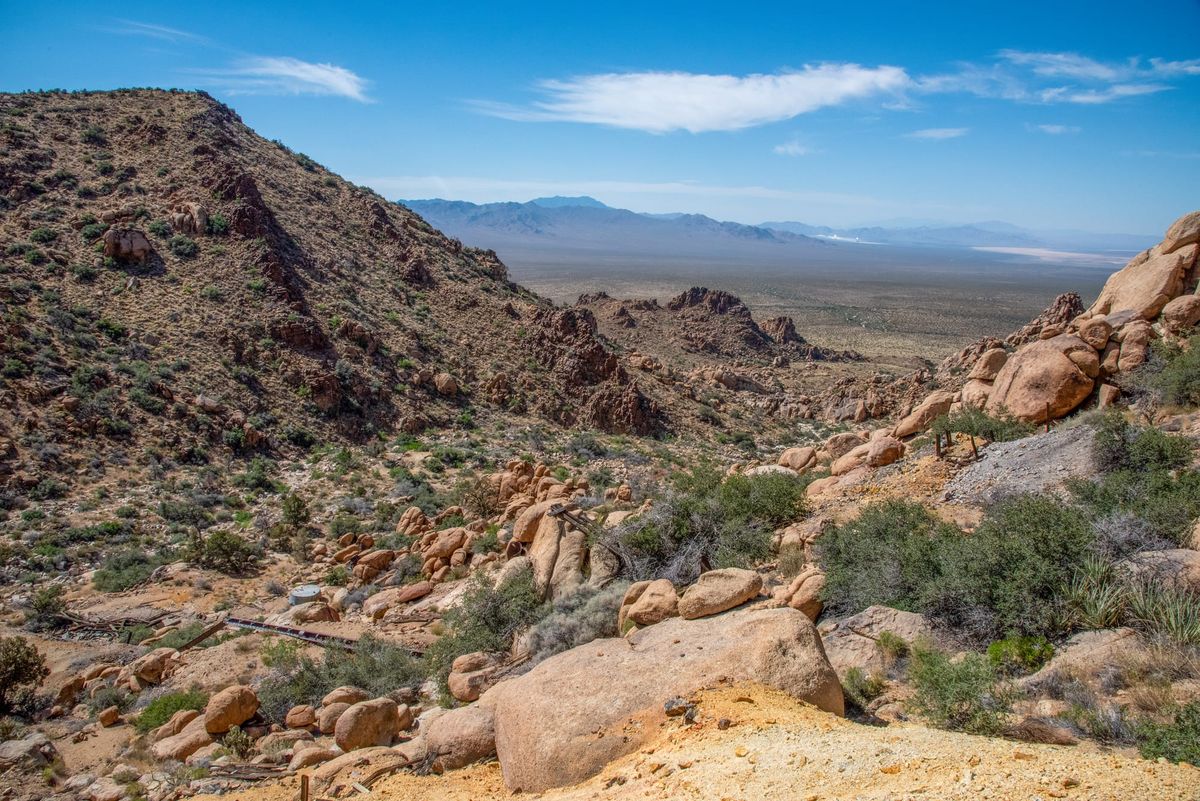
The Garvanza Mine sits in an unnamed canyon on the north slope of the New York Mountains. Few visitors find their way in, mostly because of the road: the last mile is a slow crawl over large boulders. From there the hike is a scramble up a wash with no trail.
Most published references put the Garvanza in Cliff Canyon, but the workings sit in a separate canyon a short distance east of it, on the same flank of the mountains. The mine is also tied to the Carbonate Group, a cluster of small workings nearby, though the sources split on whether it belongs to the group or only sits next to it.
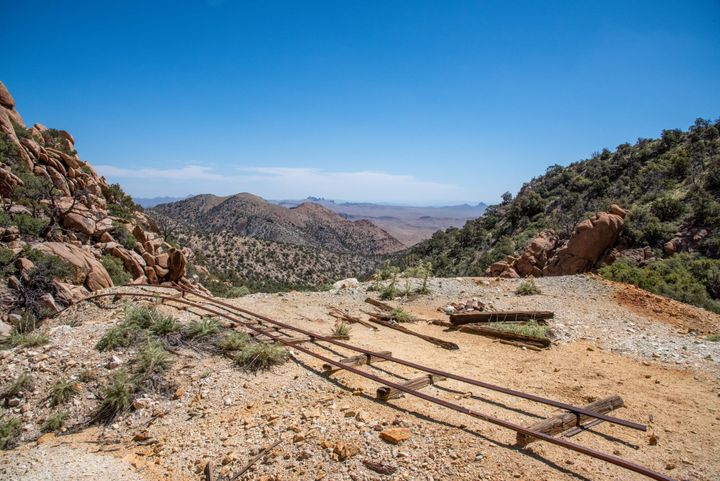
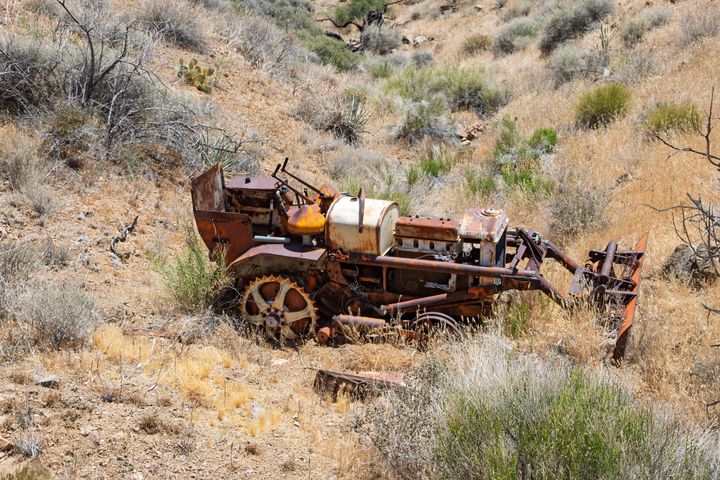
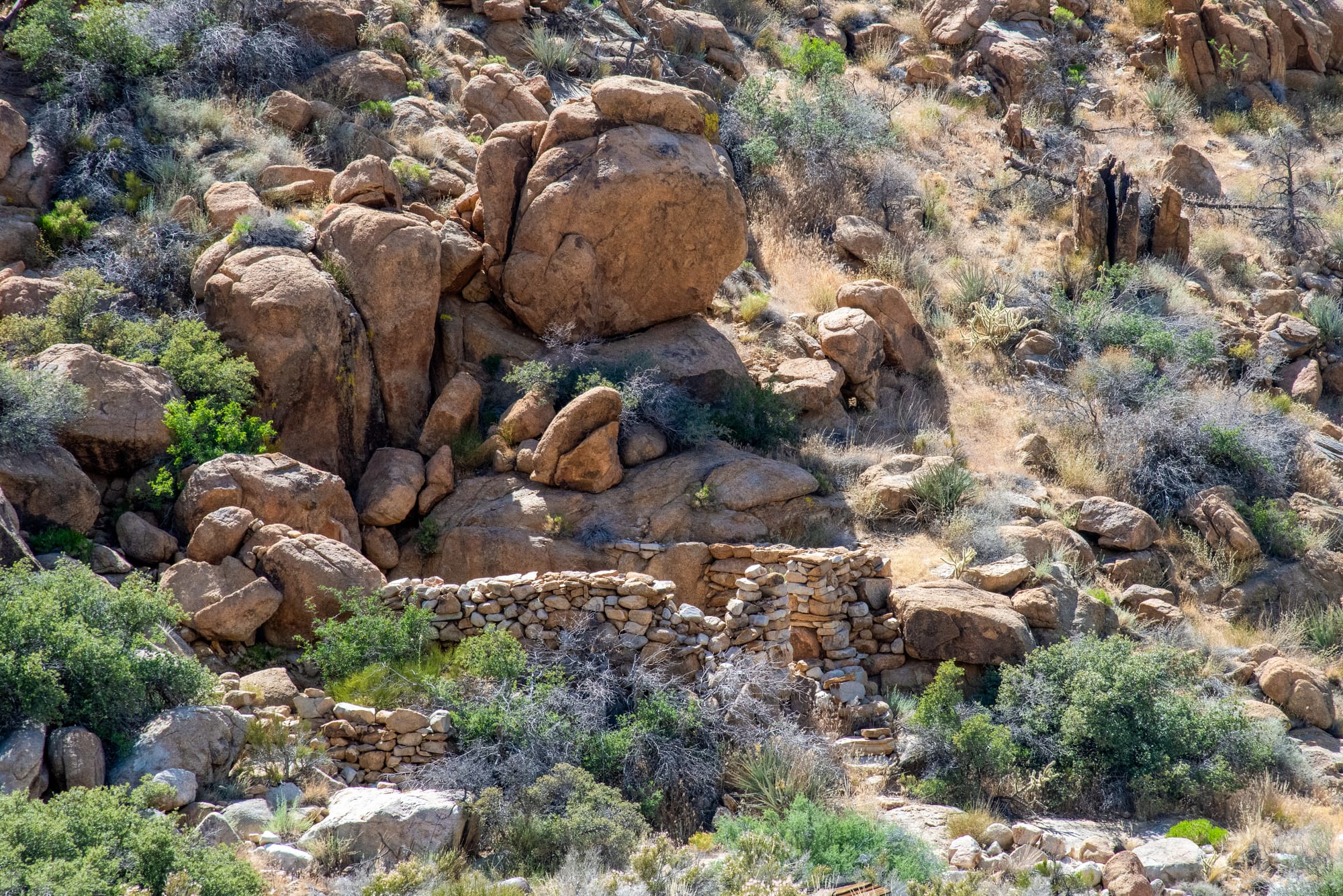
Most everything is gone, but the workings, the mill site, and the stone cabin ruins make a good afternoon of exploring. The mine rises up the east wall of the wash in three levels, with foundations, ore chutes, two adits, and a shaft still in place. From the top, the view runs across the Ivanpah Valley to I-15 and the Ivanpah Solar towers.
History
The Garvanza was first explored in 1905, and by 1907 the Garvanza Mining and Milling Company of Michigan was working it for silver, copper, gold, and lead. The first recorded production came in 1908: 45 ounces of silver and 455 pounds of copper from two tons of ore. That summer the company put in a 25-ton reduction plant, but its power plant proved inefficient, and the mill ran only three months.
By late 1909 the owners had found molybdenum and thorium in the ore and were planning a plant to make thorium nitrate, though thorium made up only about 0.05 percent of the ore. Nothing came of it. The mine ran intermittently through 1919.
Demand for tungsten soared during World War I. Tungsten hardens steel, and the military used steel alloys for weapons, tanks, and ships. The Garvanza and the Mojave Annex nearby shipped a few tons of high-grade tungsten ore around the war years, and the Sagamore, idle for years, reopened for tungsten too.
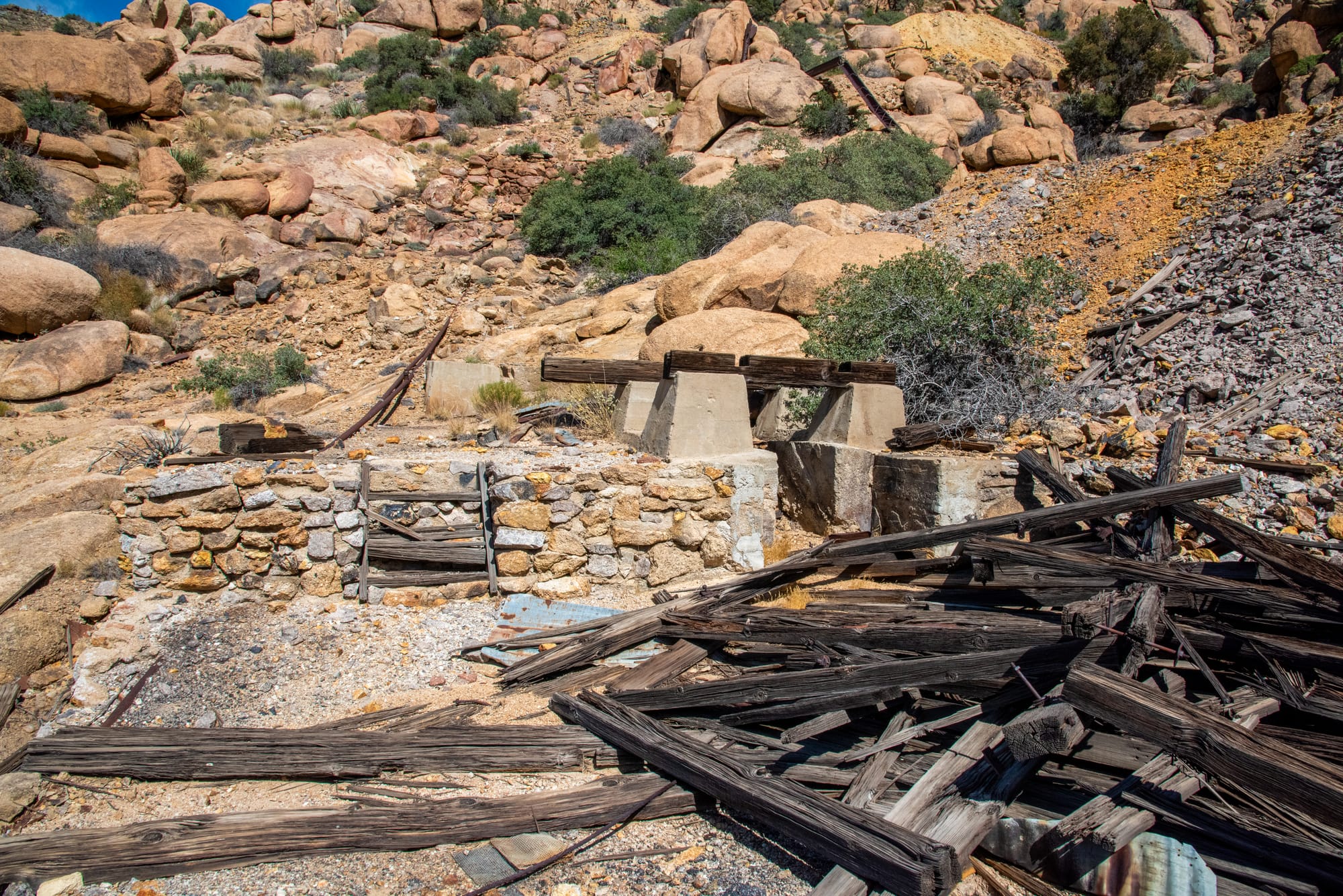
The rock here is Teutonia Quartz Monzonite, a granite cut by shear zones that hold thin quartz veins. The ore was in those veins: copper, lead, zinc, and tungsten in one package. The thickest vein was only about ten inches.
Miners drove two adits, at least 260 and 240 feet long, into the main shear zone. A shaft at least 110 feet deep drops from the mouth of the upper adit and meets the lower one 85 feet down, and the lower adit has a fifty-foot winze of its own. A Park Service inventory of the site lists a well, a foundation, a cairn, a millsite, a flume, a shaft, two adits, and three cabins.